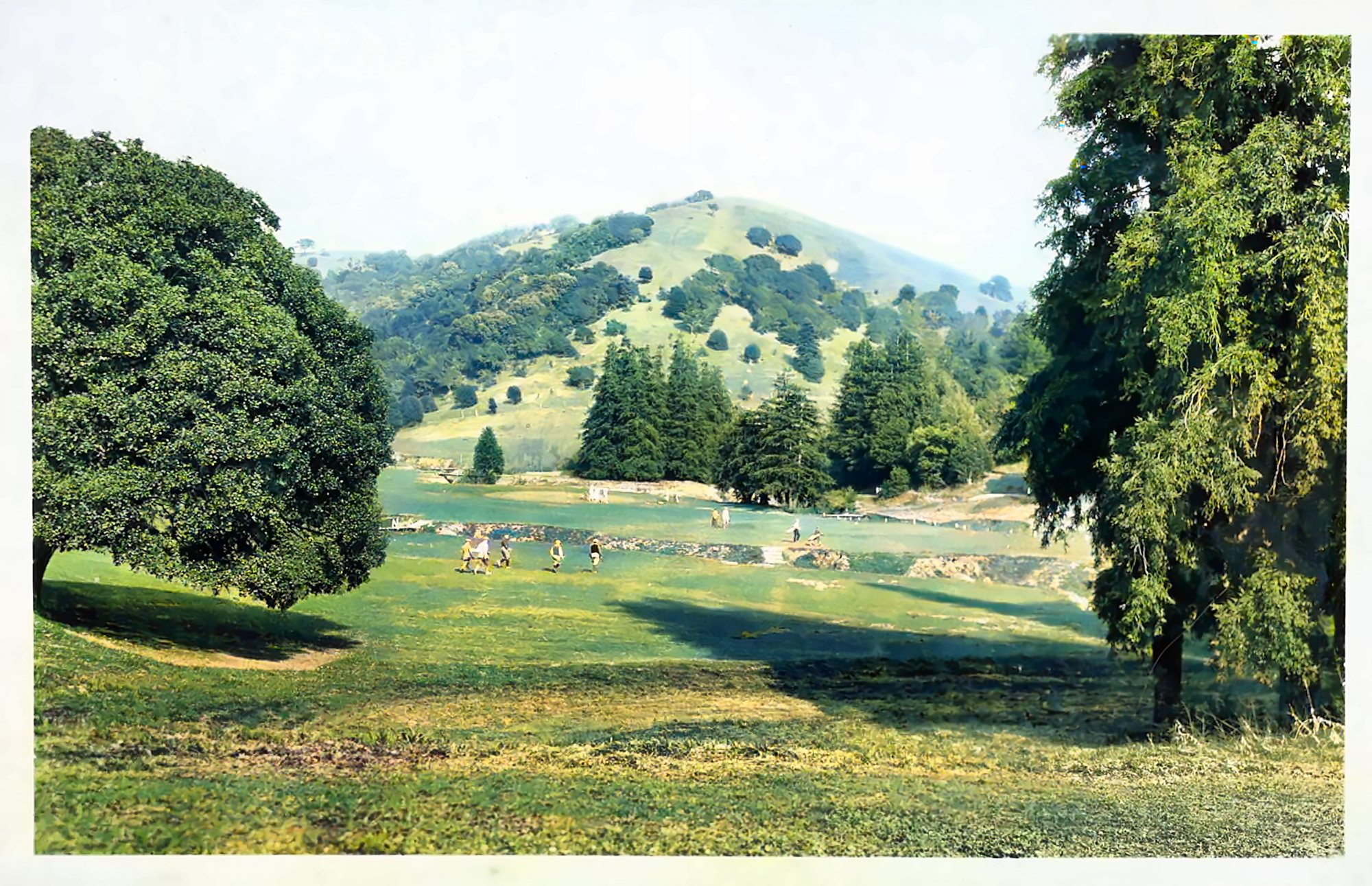
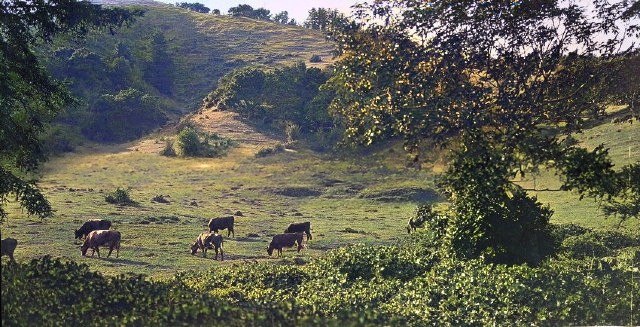
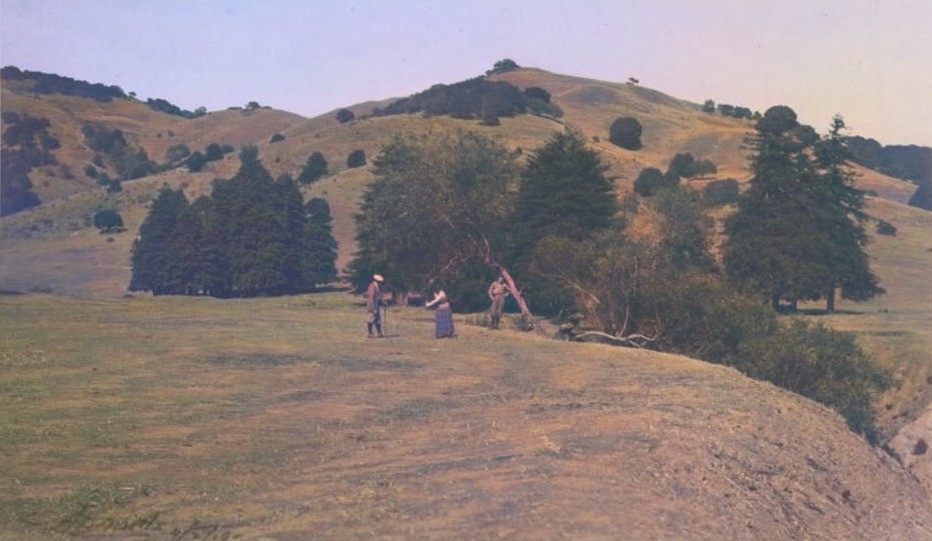
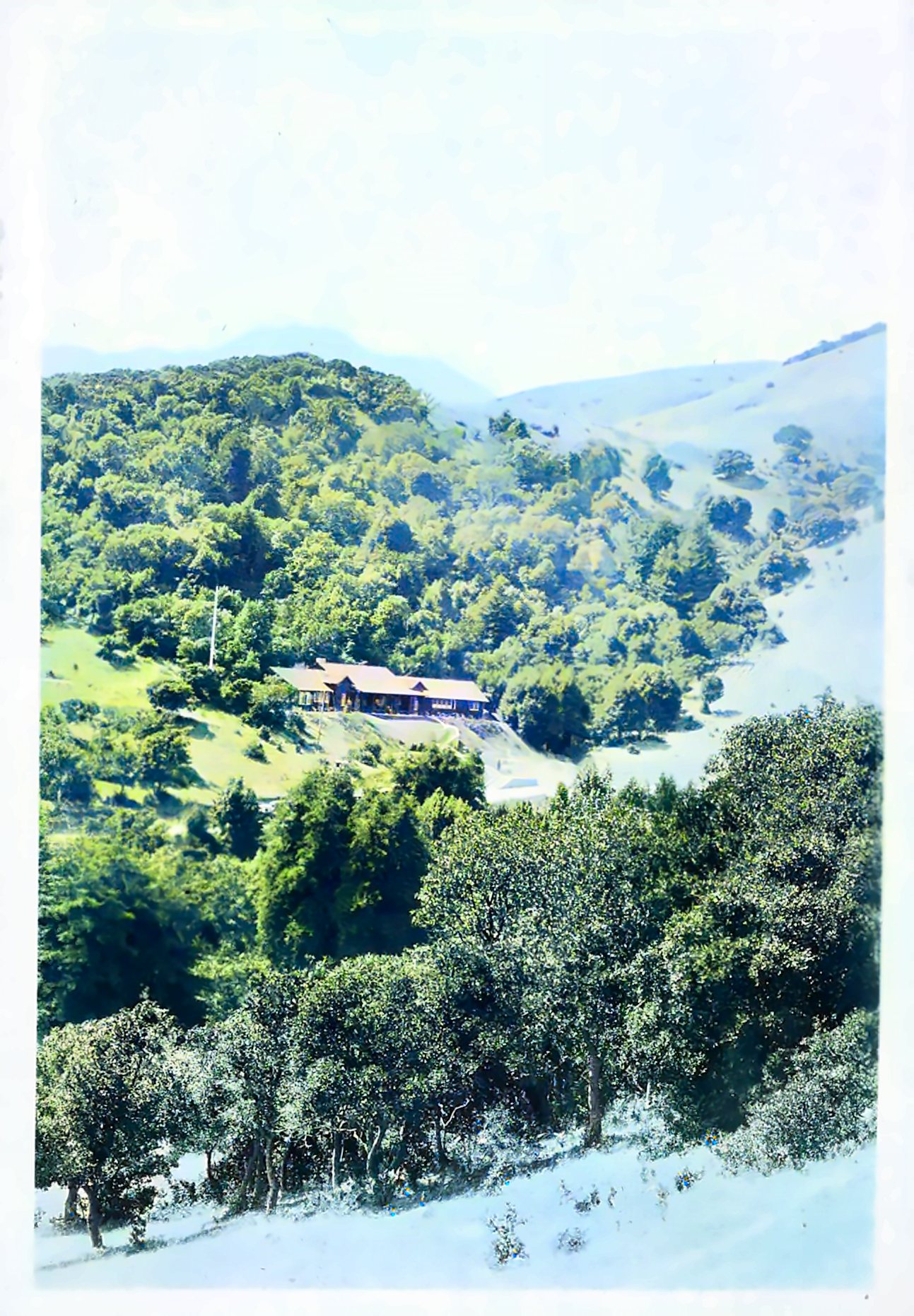
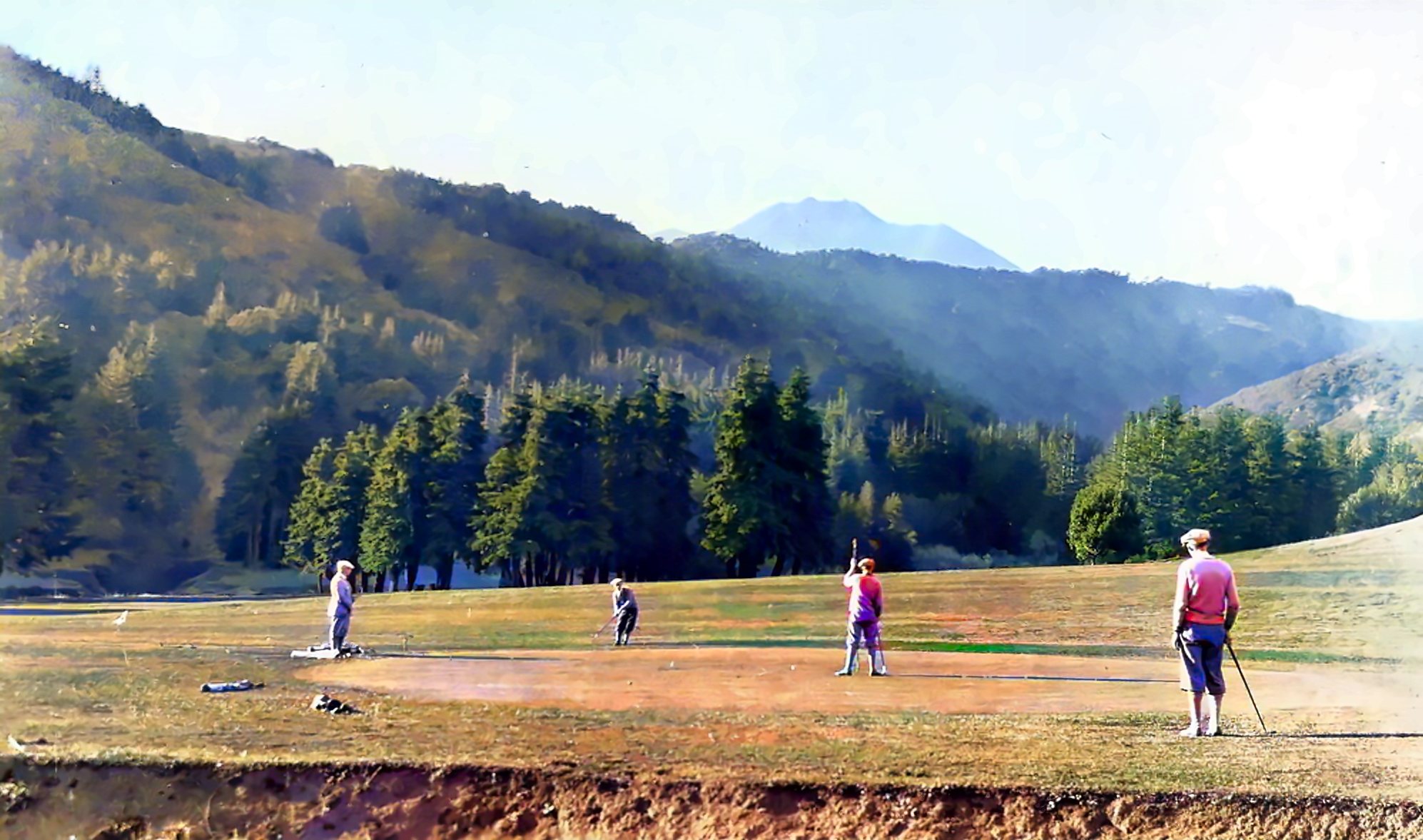
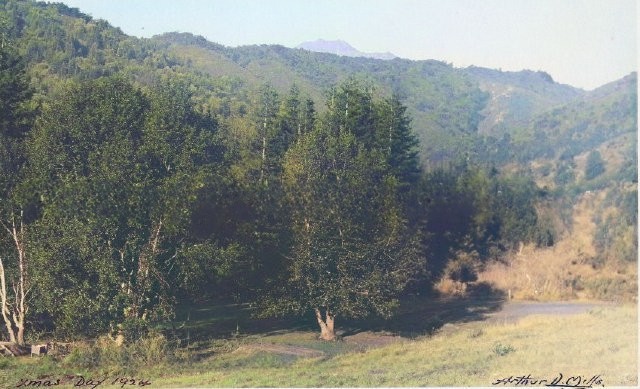
A Cow Pasture in Warner Canyon
The story of the land starts with a mapmaking mistake. When surveyors ran the lines between the two great Mexican ranchos of southern Marin, Saucelito and Corte Madera del Presidio, they found a wedge of land that belonged to neither. It held somewhere between 300 and 400 acres. When the United States took over California, that wedge became government land, and the Record later called it the "Lost Acreage."1 In 1939, as the city prepared to buy the golf course, the Record reminded readers that "originally a part of the land had been government land."2
The first claimants on paper were the Cushings. On March 15, 1882, Dr. Sidney B. Cushing of San Francisco received a patent signed by President Chester A. Arthur for 162.01 acres of the wedge, and on May 20, 1884, his mother, Mrs. Harriett Cushing, received 158.54 acres more. It was Dr. Cushing who named the district Blithedale.1 Another San Francisco man, the dentist Dr. Alexander Warner, held a further part of the Lost Acreage.1
Before any of them, the valley had a legend. James H. Wilkins, a pioneer newspaperman, wrote that in the 1860s Mill Valley had exactly two inhabitants: a cultivated, free-spending stranger called William H. Dalrymple and the woman known, "by courtesy only," as Mrs. Dalrymple.3,1 A 1929 telling, signed only "by a pioneer," put "their exact place of residence" "within the limits of the present golf links," beside what early maps called Dalrymple Creek.4,1 In Wilkins's telling, Dalrymple married her on his deathbed and left her a Baltimore fortune.1,3 No record of the house has turned up, so the tale is best treated as legend.
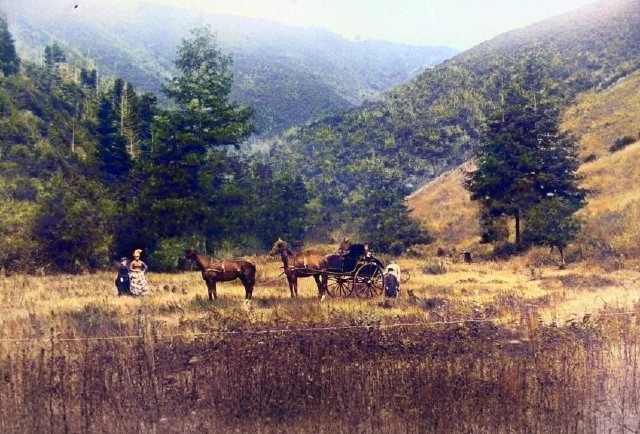
The Warners have better evidence behind them. Dr. Warner acquired the canyon that took his name in 1884.5 Library photographs show the family there in the mid-1880s.6,7 When he died in May 1919, just as the golf club was being born, the Record wrote that he "has left his name permanently to one of our beautiful canyons," which Bay Area Boy Scouts were by then using as a camping ground.8 One of his daughters, Alysse, had married at San Francisco's First Presbyterian Church in June 1914, and the couple lived in Mill Valley.9,8 Warner Canyon later passed to Mrs. and her sister, Mrs. Stewart Rawlings.5 The family kept a right of way across the land below to reach the canyon, and by the 1930s it ran "across the park fairways" of the golf course.10,11
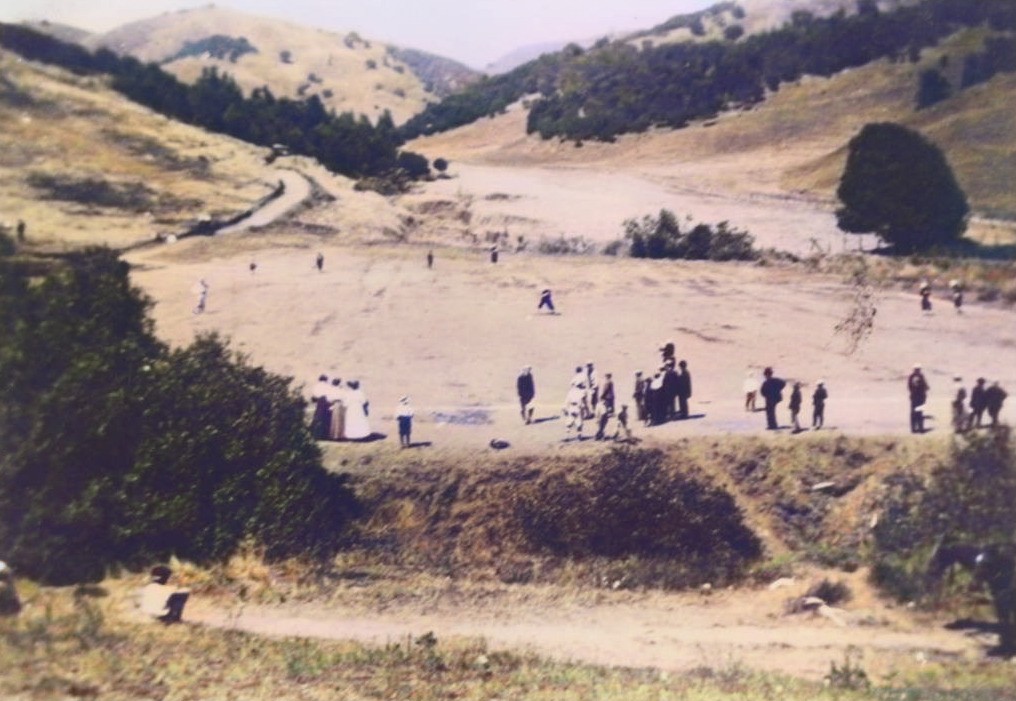
Between the town and the Warner land lay the Boyles' property. Mrs. Carmelita Boyle gave the town the land for Boyle Park, which the Record placed "in Warner Canyon."12,13 Lots in "Boyle Park sub 1 of lands of Carmelita Boyle" were being sold by 1919.14 Her son Hugh A. Boyle and his wife Ida, who lived in a handsome house on Blithedale Avenue, owned the canyon floor beyond the park.15 A 1921 tax roll put his tract at 217.8 acres. It ran up to the town limits on the south and was bordered on the west by land of "A. Warner" and others.16 Boyle Park had a ball field, and a dirt road ran past it up into Warner Canyon. A 1910 photograph shows a crowd watching a game there, with the open land behind it that would become the golf course.17
A Club for a "Sleepy Hollow"
The golf club began as a different idea. In 1939 the Record said it started "in a casual and unpremeditated fashion." A group of friends were "spending a pleasant evening at the home of Mr. and Mrs. John Finn," and someone suggested they form a social club.2
On April 15, 1916, a prospectus in the Record called Mill Valley "notoriously a 'sleepy hollow' from a social standpoint." It argued that young people and desirable newcomers were leaving because the town offered so little company.18 The answer was a family club for men and women. It would have a central clubhouse with billiards, bowling, card rooms and showers, and it would also "secure golf grounds within reasonable distance and … erect thereon a club bungalow."18 The plan needed $7,500 to $10,000. Seventy-five to a hundred charter members would each buy a $100 trustees' note, non-interest-bearing and secured by the property. Twenty-seven subscribers had already signed, among them , , (who chaired the membership committee), John Burt and R. L. White.18
The 1939 retrospective dates the first formal meeting to April 28, 1916. About seventy-five people came, with Bostwick in the chair, as secretary and as treasurer. The meeting chose the name Mill Valley Town and Country Club and favored a site on West Blithedale opposite Oakdale, with a clubhouse to be "built over the stream."2 The Record's prospectus of two weeks earlier shows the organizing had begun even before that date.18
By June the club was a legal fact. It was "incorporated as a voluntary association, non-profit sharing and without capital stock," with more than eighty members. Its officers were , the town's first mayor, as president, as vice-president and Mrs. Carl Symonds as secretary-treasurer. was a director.19 The announcement also said, without naming the place, that "good golf links, pleasantly situated and easily accessible, have been secured." A perspective drawing of the clubhouse was to be shown at the Bank of Mill Valley.19
The War Intervenes
The town club never got its clubhouse. Its members met at the Bank of Mill Valley in February 1917.20 The club then "abruptly terminated its activities when the United States entered the war," the Record said later.21 In November 1917 the Mill Valley Town and Country Club itself appeared on the town's list of subscribers to the Second Liberty Loan.22 In 1939 the Record wrote that "everyone was too busy with war activities to think or plan further for such an undertaking."2
A Picnic at Boyle Park
The project came back after the Armistice, but now it was about golf. "Men who would not have been interested in a social organization," the 1939 history observed, "were enthusiastic for the golf club."2 On Tuesday evening, April 15, 1919, the dormant club held a called meeting at the Bank of Mill Valley "to consider … the possible merging of the country club into a golf club." It voted only to look into "tenure of lease of grounds for golf links."21 The Record added its blessing: "A golf club would be a fine thing for Mill Valley."21
A week later the Record invited the whole town to a picnic. "Come to Boyle Park tomorrow if you are interested in golf," it urged. Picnickers were to gather in the park in Warner Canyon, "near the ball grounds," at one o'clock on Sunday, April 27, to hear the plans for a golf course, tennis courts and clubhouse and to look over the site.12
The 1939 history says a meeting at the Outdoor Art Club chose the name Mill Valley Country Club. Memberships were of two kinds: proprietary, with a share in the club's assets, and non-proprietary, for golf privileges only.2 The officers were , a San Francisco jeweler from Blithedale, as president, as vice-president and as secretary-treasurer.2 The full board was formally organized by September 1919. Along with those three, the directors were Bostwick, Coffin, , , and . Lowell chaired the building committee, Smith the grounds committee and Fred Burden the membership committee.23
The land question took longer to settle than the officers did. According to the 1939 history, , Bostwick and Smith negotiated for "a tract of thirty-five acres belonging to ." The deal was made in the names of two trustees, Eacret and Forbes, and title later passed to a corporation.2 The recorded deeds came later, however. Hugh A. Boyle and his family deeded 15.97 acres in the Boyle Tract to Eacret and Forbes, "and right to purchase other lands," only in February 1921.24 That same year's tax roll noted 2.2 acres already "deeded to Mill Valley Town and Country Club," the old 1916 name.16 The members who built the course in 1919 were probably working on land held under a lease or an agreement to buy, which is what the April meeting had set out to investigate. The Record never printed the terms.21
Daddy Clark's Nine Holes
To build the course the club turned to of San Rafael. The papers called him a "golf course architect" who had laid out the Marin Golf and Country Club at San Rafael and "the original Ingleside Links in San Francisco."25,26 A later city history says a committee of , Arthur Smith, Fred Burden and Frank Lockwood "was delegated to lay out the course and was employed for that purpose."27 Members soon called him "Daddy" or "Pop" Clark.28,29 His son Bob was then the professional at the Belvedere Country Club.30
The papers were confident about the timetable. In mid-June 1919 the Call reported that "one hundred enthusiastic charter members" expected to open the course with an informal tournament within six weeks. Clark promised it would be "one of the sportiest of golf courses on the coast."30 By early August the target was the end of that month, and local professionals were already applying for the job of club pro.31 Both dates proved too hopeful. The greens were only sown in August.29
The work is recorded in some detail. By September 20 grass was "rapidly growing on all the greens." A leveling machine had "worked wonders in removing the high spots on the fairways," and the ditch hazards had been regraded. The club had to ask that signs barring "automobile or animal traffic" on the fairways be obeyed.23 A year later a member remembered "'Bobby' Clark wrestling with the raw material in the almond orchard."32 By mid-October members were practicing on fairways "smoothed and cleared of obstructions," with spacious tees and cups sunk beside the still-closed permanent greens. came over on Saturday afternoons and Sundays to give lessons.33
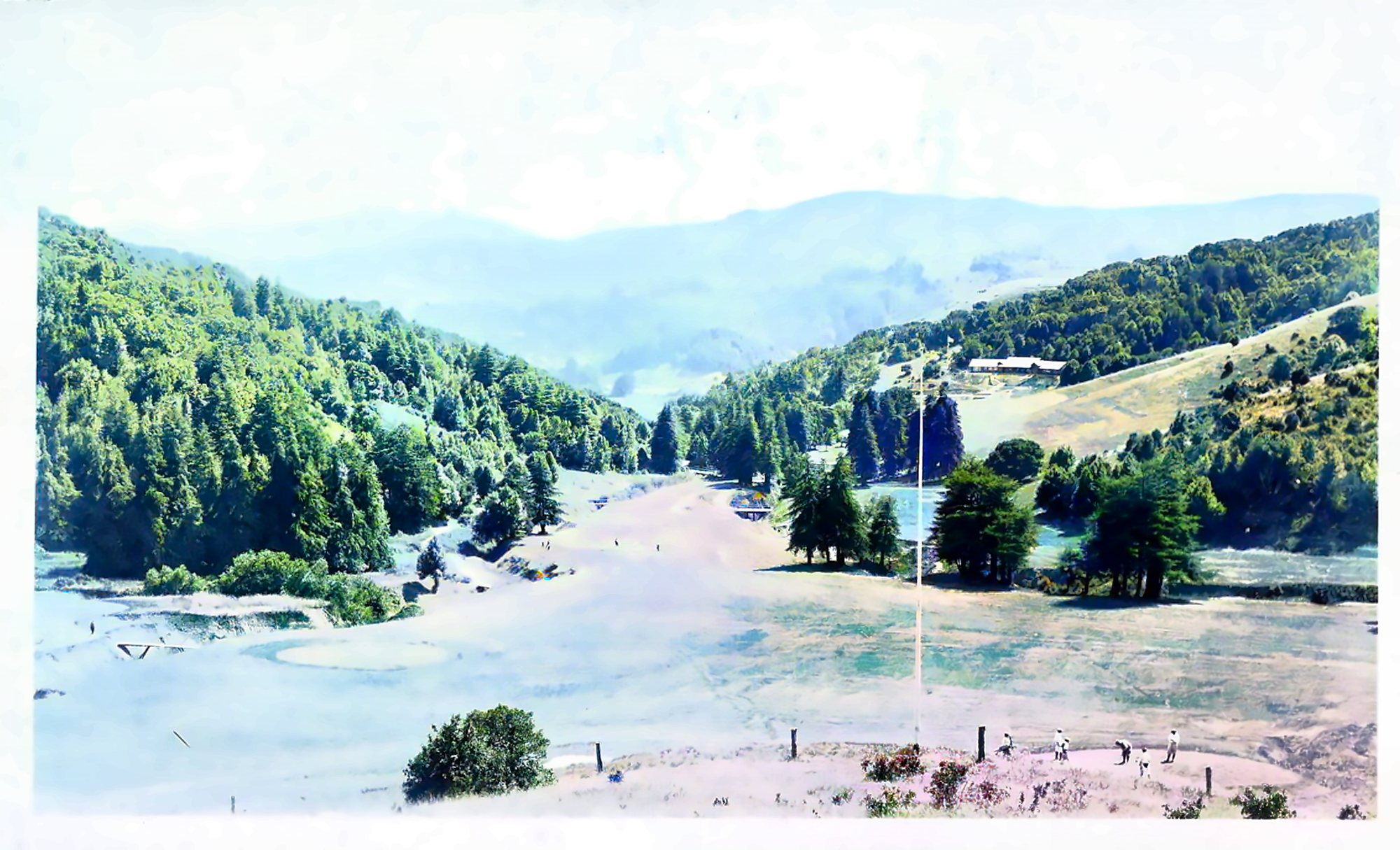
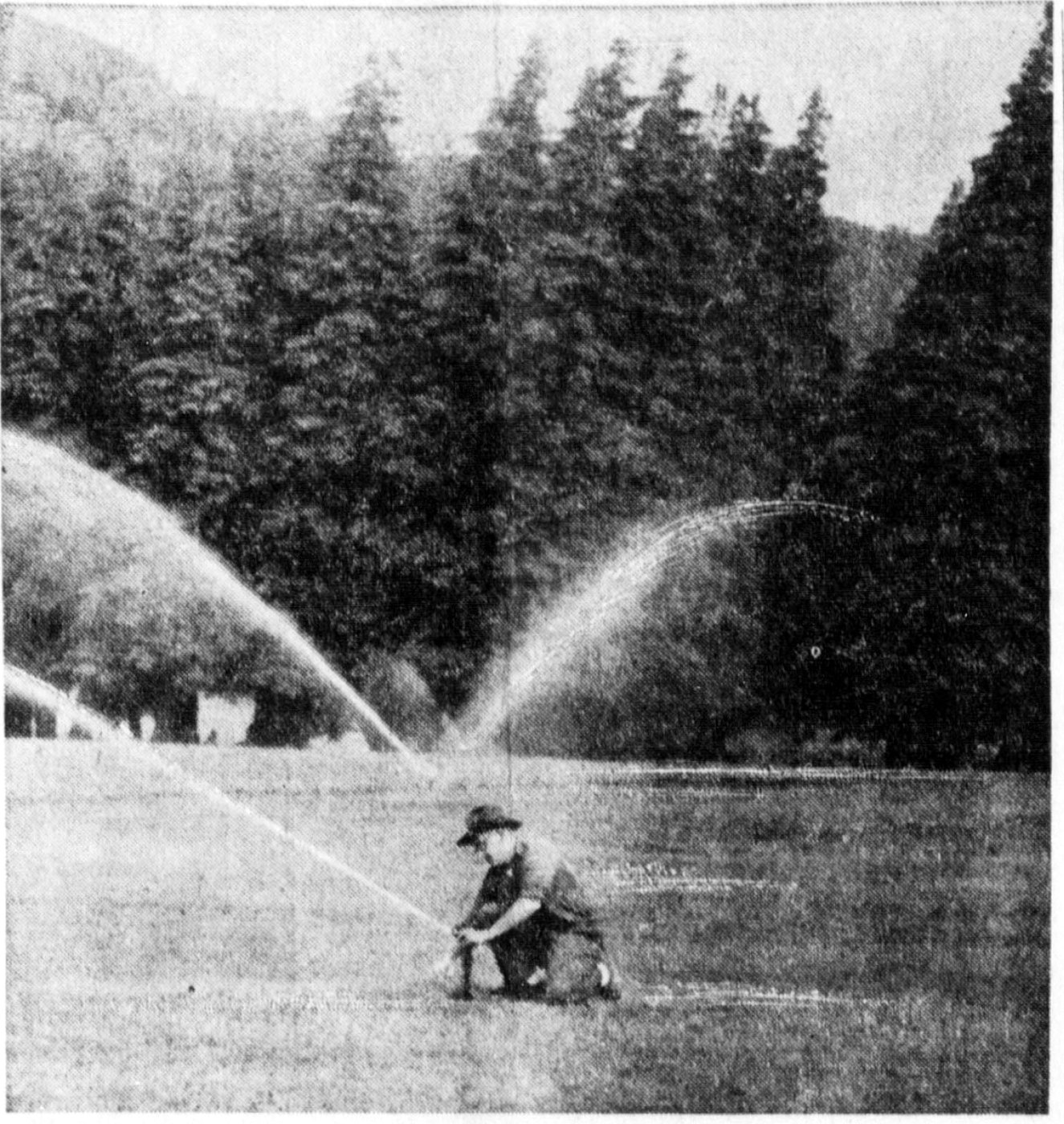
On November 1, 1919, the Record declared: "Golf is now a reality in Mill Valley."25 The nine holes measured about 2,500 yards, with "ideal natural hazards, rolling fairways and well-located greens." All but two greens were playable, and a water system now ran to the greens.25 The Chronicle's Hay Chapman later reported that the whole course, "including the building of a considerable distance of road," had cost only $4,000.29
The early columns give a fair picture of the course. Its spine was the winding creek, which came into play on seven of the nine holes, "sometimes all nine."29 The third tee looked down on "very difficult play over three creeks to the 'island.'"34 There was a muddy stretch "just east of tee seven."35 The eighth tee had a view "with stately Tamalpais in the background." Its green, 254 yards away, sat behind the barranca, and Chapman twice watched drive it in one afternoon.29 Par was 34.36 The clubhouse site looked down on the first tee and the ninth green.34 Members carried their clubs out to the canyon and back. The Record wrote that "to carry a bundle of golf sticks to and from Warner Canyon is a joy that only golfers can know."37
Golf Is Now a Reality
The last weeks of 1919 were busy. Work on the clubhouse foundations began on October 18. It was designed by the Berkeley architect "in complete architectural harmony with its surroundings," and 's committee oversaw the building.33 By late November the roof was on. "Chief" Billings had given lumber for the interior and stone for the big fireplace.35 Lowell looked out over the links and said, "I've met more Mill Valley people in the last month at the Golf Club than during the last five years in Mill Valley."35
The course was also getting its finishing touches. A. B. Ambler gave bubble fountains "at thirsty points on the course." Light-green tee boxes and a ball washer were put in at the first tee. Bob Clark was "permanently engaged as professional and greens keeper," with a club-making shop planned in the clubhouse.35 His weekends were already fully booked with lessons.34 President Eacret came back from a trip East and "was surprised at the rapid progress made since his departure."34 On November 22 the Record printed the first membership roster, close to a hundred names.37 The Finns, the Bostwicks, Coffin, Lowell and Forbes were on it. So were , the photographer who was already recording "Boyle Canyon before and after," and an "H. P. Upham," probably Ben Upham misprinted.37,38 The list also includes an "H. A. Hoyle." The same typesetting turned Hugh A. Boyle into "Hoyle" in a 1921 deed, so the landowner himself had probably joined.37,24
The beginners played badly and kept coming back. One golfer spent six of his seven hours on the links "in the creek looking for the elusive ball." A week later he said he was at the "top of my form—only spent half of my time in the creek."34 The San Francisco Call reported that the "youthful Mill Valley Golf Club is going strong," enjoying a long run of fine weather in "Boyles Canyon."39 As 1919 ended, the course was open, the clubhouse was rising, and a town that had called itself a sleepy hollow three years earlier now had its own golf club. A few weeks later the club's own column described the course as "what six months ago was a cow pasture."36
"Golf is now a reality in Mill Valley."
Notes to Chapter I (39 sources)
- “Mill Valley Country Club Once Part Of 'Lost Acreage-Historic Sketch,” Mill Valley Record, Feb. 21, 1939. view source ↗
- “Mill Valley's Park System—Chasing a White Pill Amid Beauty,” Mill Valley Record, March 28, 1939. view source ↗
- “Time Will Not Blot Out Romantic Story of First M. V. Resident,” Mill Valley Record, Aug. 31, 1950. view source ↗
- “Romance OF Mill Valley A Historic Tale OF Genuine Thrills BY A Pioneer,” Mill Valley Record, June 21, 1929. view source ↗
- “Warner Canyon Property Sold,” Mill Valley Record, Jan. 4, 1945. view source ↗
- Mill Valley Public Library, Lucretia Little History Room, Warner Family in Warner Canyon, circa 1885, object MVN1323. view source ↗
- Mill Valley Public Library, Lucretia Little History Room, Warner family members at summer home in Warner Canyon, object kt467nd13m. view source ↗
- “DR. Warmer Called.,” Mill Valley Record, May 3, 1919. view source ↗
- “Society Notes,” San Francisco Call, June 9, 1914. view source ↗
- “Archers and Kiddies Ask Park,” Mill Valley Record, March 31, 1939. view source ↗
- “Council Meets— City Asked to loin Hiway Safety Drive,” Mill Valley Record, Nov. 3, 1939. view source ↗
- “Wolf Club Progressing,” Mill Valley Record, April 26, 1919. view source ↗
- “Veterans Tax A Perplexity For The Public A Destroying Caterpillar Arraigned; Water System Discussed,” Mill Valley Record, Aug. 28, 1931. view source ↗
- “Documents Filed IN Recorder S Office,” Marin Journal, Nov. 27, 1919. view source ↗
- “[the passing throng 11,” Mill Valley Record, May 15, 1920. view source ↗
- “Delinquent Tax List,” Marin Journal, May 26, 1921. view source ↗
- Mill Valley Public Library, Lucretia Little History Room, Ball game along side of road to Warner Canyon in the Boyle Park area, object kt296nc9wz. view source ↗
- “Notes ON Town And Country Club,” Mill Valley Record, April 15, 1916. view source ↗
- “Objects Of Country Club IVrsiifotivf Plans of Bountiful Town and Country Club House to be Exhibited Shortly,” Mill Valley Record, June 17, 1916. view source ↗
- “The Passing Throng C Local and Personal Paragraphs of General Interest to People of Mill Valley and Vicinity,” Mill Valley Record, Feb. 17, 1917. view source ↗
- “A (Joi,U lUBI,” Mill Valley Record, April 19, 1919. view source ↗
- “List OF Mill Valley Sl USITtIKEKS TO Second Liberty Loan,” Mill Valley Record, Nov. 10, 1917. view source ↗
- “m:»s from the hole cli ii Vein Mies Progressing—New I.inks Under Way,” Mill Valley Record, Sept. 20, 1919. view source ↗
- “DE Kds I,‘M'okdkd,” Mill Valley Record, Feb. 19, 1921. view source ↗
- “Golf 1,1 \US Com Pi.ktk Mew Mill Vnlley I oinilrj Pluhlioiise and Ini|Mirlnnl Community Vsset,” Mill Valley Record, Nov. 1, 1919. view source ↗
- “Brief Mentions OF General Interest,” Marin Journal, Nov. 6, 1919. view source ↗
- “Golfing in M. V. Dates Back to 1919 When Country Club Formed,” Mill Valley Record, Jan. 9, 1947. view source ↗
- “Hill Valley Country Club,” Mill Valley Record, Jan. 31, 1920. view source ↗
- “Mix Months Old Uolf ( Liu Mill Valley Club Is a VoiiiikhUt, but Course I» Oood One Already,” Mill Valley Record, Feb. 14, 1920. view source ↗
- “Ford Claims Troeh Did Not Win In Trap Shoot At Olympic Lodge Meet,” San Francisco Call, June 19, 1919. view source ↗
- “g,” San Francisco Call, Aug. 7, 1919. view source ↗
- “Golf t'Ll'H Iseiv.s Chili Passes First Aimii ersary So Busy Playing Game No One Takes Time to Celebrate,” Mill Valley Record, Nov. 20, 1920. view source ↗
- “The Country Club Artistic Clubhouse Is In Process of Erection,” Mill Valley Record, Oct. 18, 1919. view source ↗
- “Mill Valley Golf Club Golf Eiitlinsiusin Revolutionizing Soeial Activities,” Mill Valley Record, Nov. 15, 1919. view source ↗
- “•Hill Valley Golf Cub \Km's Slices from Hie Links by Publicity Chairman,” Mill Valley Record, Nov. 29, 1919. view source ↗
- “Tomorrow. Rain OH Shine llliiid lliniili(‘ii|t Toui'nunienl oii me Hull I.inks,” Mill Valley Record, Feb. 7, 1920. view source ↗
- “The Gulf ( lub,” Mill Valley Record, Nov. 22, 1919. view source ↗
- “(101,F (M B News ( Inti House Furnishing Completed Other Notes,” Mill Valley Record, March 20, 1920. view source ↗
- “/mir,” San Francisco Call, Nov. 28, 1919. view source ↗
The Club Years
"What Six Months Ago Was a Cow Pasture"
When 1920 opened, the Mill Valley Country Club had nine holes in play in Boyle Canyon and half a clubhouse on the hill above them. The Chronicle's golf writer, Hay Chapman, counted it as the newest of the clubs that the postwar golf boom had brought to the Bay Area: it had put nine holes into play a few months earlier and was now building its clubhouse1. A month later the club's own column announced its first tournament, to be played "on what six months ago was a cow pasture"2. Frank Walsh won it on February 8 with a 953.
The man who had turned the pasture into a golf course was still on the grounds. of San Rafael, whom the members called "Pop" or "Daddy," had laid out the nine, and in January 1920 the board gave him complete charge of maintaining the course and hiring its labor4. Chapman called him the "father of construction" and the father of two professionals, Bob and Harold5. He mowed the fairways behind a horse, and the column joked that no train engineer was more polite than backing his horse mower off the course to let players through6. A year later the column remembered him as the man "who knew all the little blades of grass on the greens by their first names"7.
"The vista from the eighth tee, with stately Tamalpais in the background, provides ecstasy for the artist and a sufficient alibi for any golfer's distraction."
His son Bob, formerly of Belvedere, was the club's first professional. Chapman watched him drive the 254-yard eighth green twice in one afternoon, over the barranca that guarded it5. That creek was the course's signature. Chapman counted it as a hazard on seven of the nine holes, and sometimes on all nine5, and members soon called No. 3 "Hell's Fairway"8. lived in quarters in the new clubhouse9. That winter he opened a golf "studio" in town as well, opposite the Hub Theatre, at $1.50 a half hour10. In March 1921 he won an invitational amateur-professional tournament at Byron Hot Springs with 149 for 36 holes, ahead of John Black of Claremont11,12.
The club filled fast. It had about 120 members by the end of January 1920, and the first annual meeting in June capped the membership at 150 and abolished summer memberships6,13. By December the membership had been full for some time, with a long waiting list in the secretary's hands14. That month heavy rain closed the greens for the first time. Until then the game had been played without interruption for nearly fifteen months14.
The boys of Mill Valley came with the course. In January 1920 the club listed its official caddies by name, and the column was proud of them: "If the future citizens of Mill Valley are to be gauged by the young gentlemen who are now listed as official caddies, this will be a representative community"15. In March a visitor found Oliver Sollum serving as caddie master over seventeen boys. They were paid by the nine holes, and their caddie house was still only a shed16. Caddies could play the course on Fridays17. By 1924 the club held an annual Caddy Tournament in which the members carried the bags. Russell Mills won it with 84-10-74 and took his choice of a club from the shop of the professional, Arthur Whiting. One member boasted that the club had "the finest bunch of Caddies of any club in the United States"18. A Russell Mills was on the caddie list in 1920, and he was probably the son of the club's photographer, , whose son Roy's 1949 obituary names a brother, Russell C. Mills16,19.
A Clubhouse on the Hill
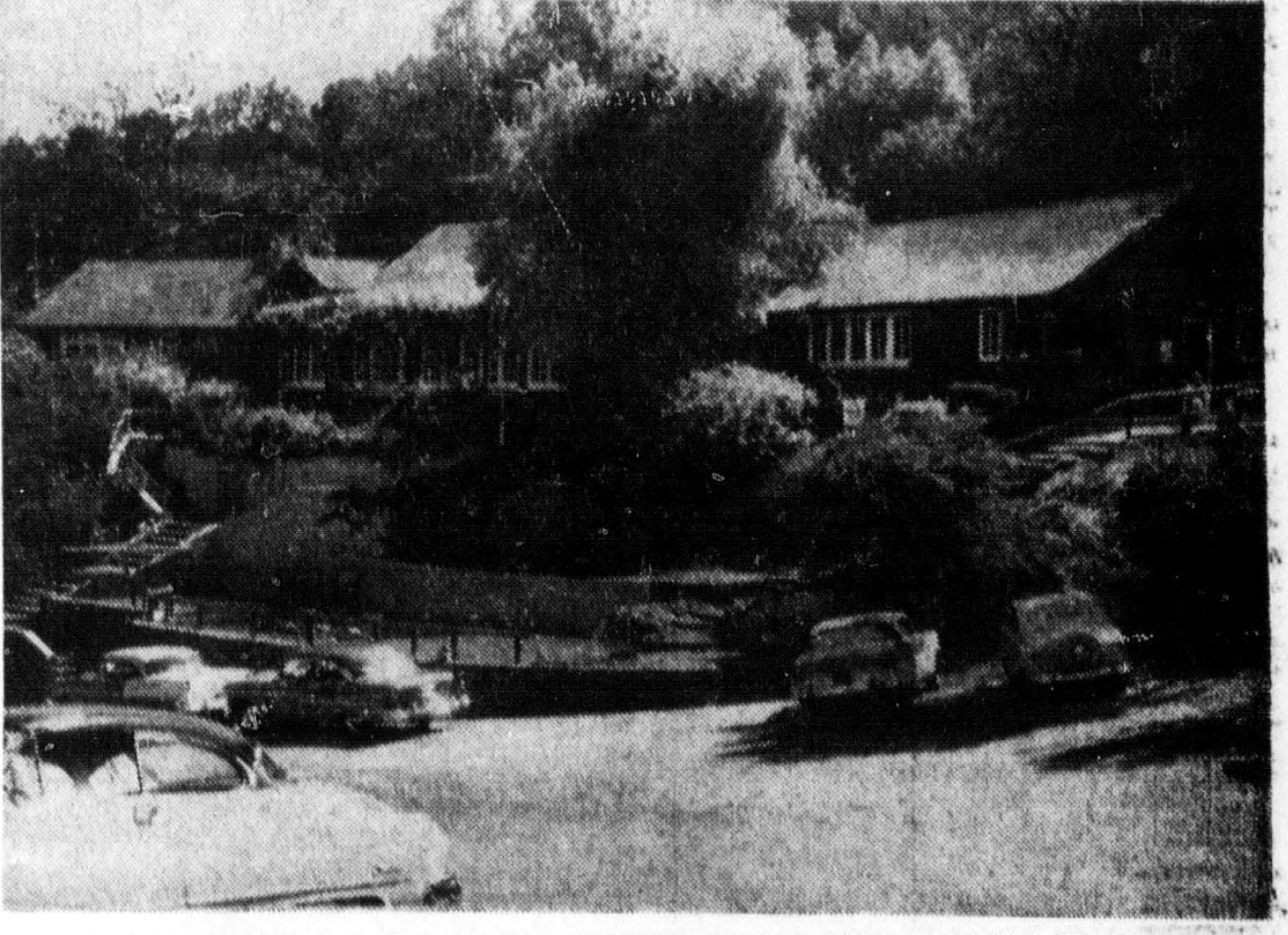
The Berkeley architect had designed the clubhouse to follow the contour of the hill, with a porch that looked down on the first tee and ninth green21,9. It was built in units as money allowed. Pacific Golf and Motor reported that the course had cost $4,000 and the first unit of the clubhouse $6,000, "a triumph in golf economy"22. (Chapman's article, as scanned, gives the same unit as "18,000," probably an OCR error.)5 In January 1921 Chapman held the club up as a model for any new club. Its organizers had $10,000 in hand, bought only enough land for nine holes, spent all they could on the course and put the balance into a modest but "thoroughly comfortable and cozy clubhouse"23.
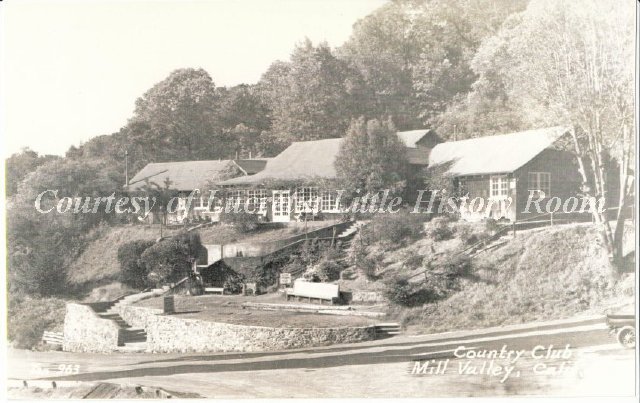
The women of the house committee furnished it. Mrs. J. J. Greely's committee chose wicker furniture in natural oak and set a big table and settee in front of the fireplace, on a polished floor of Australian hickory, and club women sewed the drapes24,17. A caddy house went up north of the clubhouse3. Players climbed from the ninth green to the clubhouse up a steep path called the "Devil's Slide," which the club planned in 1920 to replace with gravel and redwood steps22,25. In the summer of 1921 the slope in front of the clubhouse was graded, with concrete retaining walls and a hedge planned along the top26.
By November 1920 the second and third units were nearly done7. On New Year's night 1921 about seventy-five members sat down to dinner in the completed clubhouse. Mrs. 's committee did the cooking, President and three other members carried in the turkeys, and gave an address for the formal opening of the club27.
The building became the center of a busy social life. Saturday-night dances to a new Victrola began in August 1920, open only to members because the floor was small29. There was a masquerade in February 1921 and a "days of '49" costume party that fall30,31. In 1922 the club began holding barbecues in the redwood grove on the golf grounds, cooked on a big grill designed by , who acted as chef32. led a procession of members from the clubhouse down to the grove for the first one33. A Fourth of July "Kid Party" that summer brought out new green grove furniture and electric lights for the Chinese lanterns34. At the 1923 barbecue Hawaiian musicians played under lanterns strung in the redwoods, and the Record closed its account with a tribute: "The Country Club is preserving one of the most attractive valleys in Southern Marin"35.
The parties grew more elaborate as the decade went on. At the 1928 annual dinner Mrs. , the president's wife, led about seventy-five guests to the fourth tee. There, by bonfire and colored flares in the redwoods around the fourth fairway, Harold Bunn and a dozen members staged a Maori haka, with Tom Patterson as the enemy chief who was "sacrificed"37. The 1929 season opened with a costumed "Blethering Contest," a tournament in which players could heckle one another. Bunn played as a flapper and as Charlie Chaplin, and a kilted foursome was piped into action38.
Presidents, Pros and Low Dues
, the San Francisco jeweler who had led the club since 1919, presided through its first seasons13,27. By the fall of 1922 was president39. , a bond man, held the office in 1924, the year he also won the Directors' Cup40, and he was still "" in the autumn of 192541. was elected president at the annual meeting of June 1927, with Lucien Marsh as vice-president, and Marsh was president by the fall of 192842,37. The women had their own leaders. Mrs. Jenkins captained the club's women's team at a 1922 invitational and played to scratch43,44.
Behind the presidents stood the secretary-treasurer, . When he asked to step down in June 1927, the Record called him "the financial father of the institution since its inception." It said his conservative advice had put the club in a strong financial position, "unique as a club of low dues and no assessments"42. The books bore that out. In 1923 the directors put the club's book value at $350 per proprietary member, counting the land only at cost, and decided to fill the last fourteen of its 150 memberships46.
The professionals changed more often. In September 1922 Bob Clark made the first hole-in-one on the links, at the fourth, in a round of 2948. The Horton Company sent him a dozen balls and a steel-shafted driver made to his order as prizes49. By mid-October his resignation was in the directors' hands50. His successor in January 1923 was , a graduate of St Andrews University and once a golf architect in partnership with his brother. Watson and member Leslie Symmes, a soils and drainage expert, were to rebuild the troublesome 6th and 9th greens, and the club took over the lessons and the sale of clubs and balls itself51. Watson was engaged for only three months51, and by the spring of 1924 Arthur Whiting ran the shop18.
The course was short and full of trouble. It measured 2,359 yards in 192022, and par was 66 in 1928, when Harold Bunn, the tournament chairman, shot 68, the lowest amateur score since the club began52. Frank Ankers made the first eagle, holing a mashie second at the ninth in August 192029. Allen Penfield did it again in 1922 on the same hole, 284 yards from tee to green53.
Matches with the Neighbors
The new club wanted to see how the best players handled its course. On April 25, 1920, it put up a purse for an exhibition foursome. John Black of Claremont, who held the open championships of both Northern and Southern California, and his brother Bob of the Sequoia club played of the Marin club and Bob Clark of Mill Valley54,55. The Record never printed the score. It did report that spectators found a match easy to follow on the little course, from the clubhouse along the ninth fairway and across the creek to the fourth green, and that "John Black said he would like to take No. 3 home with him to Claremont"56.
Team golf with the other Marin clubs began that month. In its first inter-club match the club beat Belvedere 29 to 4 at home, and then won the return match at Belvedere57,58. The Marin Golf and Country Club at San Rafael was harder. Marin won both halves of the first home-and-home in the fall of 1920, and in the spring of 1921 it won again, 19 to 1059,60,61. In the summer of 1921 the three clubs began a series for a perpetual cup and the championship of the county, decided by the total of eight men's scores over three courses. The Record framed it as age against youth, the Marin club of twenty-three years against the Mill Valley club of two62. Youth led after two rounds but lost the final at San Rafael, 2042 to 208963. Then, in a driving rain on November 27, 1921, Mill Valley beat Marin 11 to 8 at home, the first time Marin had lost to it in a home-and-home. The next morning, the Record said, the Marin men lifted their hats to the winners on the ferry64.
The prize came in 1922. On July 23 Mill Valley won the county championship, with Marin fifteen strokes behind65. That fall about forty members held a stag dinner for the champions, and Eacret presented gold medals in "an irregular bell-shape with bordering wreath and crossed clubs in relief"49,39. Marin won the title back in 192366. In 1925 Mill Valley and Marin finished tied and talked of a play-off67. In 1927 Mill Valley took the first round of the new "triangle" series at Belvedere, 588 to 590 to 599, with Stanley Helmore's 65 the low score, but Marin won the championship by fifty strokes68,42. In 1928 Belvedere won it, with Mill Valley second69.
Mill Valley also played Santa Rosa and Berkeley, and its women played the California and Lincoln Park clubs71,72,73,29. Not every match went well. In March 1925 Berkeley beat a 22-man Mill Valley team 26 points to nothing, in a heavy fog that was new to players used to a clear sky72. By 1929 the Tamalpais High School golf team practiced on the links three days a week, and one of its matches was held up for several minutes "by a herd of deer on the eighth fairway"74,75.
Mr. Mills's Camera
Most of the pictures we have of the club in these years come from one member. of Hillside Avenue was a painter and photographer. By March 1920 he was doing photography and caricature of the club's people and scenes, and he had "complete photographic records of Boyle Canyon before and after the time that contented cows were replaced by the discontented golfer"17. His four-year-old son Cyril came along with his own clubs to watch his father take pictures, and several members were trying to talk Mills into destroying the pictures of their swings taken before they learned proper form6. Pacific Golf and Motor ran his view from the eighth tee toward Tamalpais as "Mill Valley's Matchless Vistas" in 1920, and seven more of his golf scenes in January 192522,77. By September 1925 he was the official photographer of The Fairway, a San Francisco golf magazine78.
While the others played, Chapman wrote, Mills liked to perch somewhere in the woods or hills and photograph them77. That habit put him in the middle of the club's best-known wildlife story. One Sunday that winter Mills was painting at his easel in the brush near the fourth green when a match between Frank Walsh, Godfrey Eacret and Ben Upham was interrupted by a mountain lion. Mills chased it up the hill with his tripod77. Later that month the members planned a round-up79.
"A huge, tawny creature he was. As I came over the rise he was perched on a rock, and we stared at each other, not a stone's throw away."
The deer were part of the course. In 1922 Bob Clark, going round one night to shut off the water on the greens, met a buck on the bridge to the third green, and a drive into the barranca from the ninth tee flushed about thirty quail81. In 1926 a buck, two does and three fawns were living on the fairways, and Eacret was teaching one doe, which he had named "Salley," to pose for her picture82.
Mills gathered his golf pictures into an album, A Visit to the Mill Valley Golf and Country Club. It follows the course from the first tee to the ninth, with the club's presidents, teams, caddies and characters along the way, and one page is dated Christmas Day 192420,70. In January 1925 the Record reported that he was arranging a new group of photographs of the club grounds for Pacific Golf and Motor and The Fairway84.
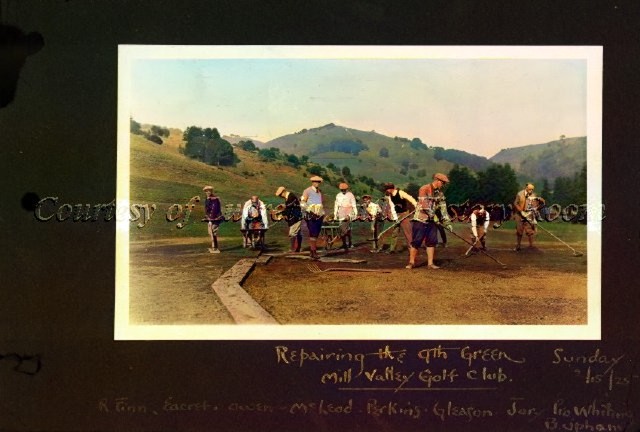
Then came the storm. On Wednesday, February 11, 1925, almost no one could reach Tamalpais High School, and the school's column in the Record joked about issuing bathing suits85. The following Sunday Mills was out on the trails with his camera, wading through water and mud. He sold forty-three storm photographs at Tipping's Service Pharmacy and gave the money to the fund for repairing the town's streets and trails86. A second album, which he made for the editors of the Record, survives at the Mill Valley Library. Two of its pages show the work of repairing the ninth green87,88. The Record's golf column, so talkative in other years, is silent about any damage to the course, so the album is our only record of it.
Houses at the Edge of the Fairways
The club owned its land, and the land around it was about to change. In February 1921 Hugh A. Boyle, his wife and others deeded 15.97 acres of the Boyle Tract to Eacret and Forbes as trustees, with the right to buy more89. More deeds followed in October 1922, for parts of a 35.97-acre tract90. Hugh A. Boyle's remaining land, 215.6 acres on the 1920 tax roll, ran to the town limits91.
In May 1922 came back to her house at Blithedale and Elm and prepared to put the family's land on the market through the Nash Realty Company. The Record added one sentence that matters to every golfer who has crossed Buena Vista Avenue to reach the first tee: "A new road is to be put through the land, opposite the Golf Grounds, surveying having already begun"92. The same week, an agent for T. Deffebach, who owned much of the land along Blithedale, asked the town trustees to extend the sewer. He said the plan would take in "the Boyle Tract, the Golf Club and adjacent lands," some 500 acres in all93. The papers do not say where the new road ran, or whether it became the stretch of today's Buena Vista Avenue that now separates the clubhouse hill from the course. In 1920 Buena Vista was already the main avenue to the golf links94. A survey map from 1922 would settle the question.
The houses came at the end of the decade. In August 1928 Country Club Manor went on sale: "those beautiful wooded rolling sunny hills and knolls adjoining the Mill Valley Golf and Country Club." It was a restricted tract for families of moderate means, and it began at the end of the Buena Vista Avenue pavement at Boyle Park96. Whether today's Country Club Drive grew out of that tract, the Record does not say.
For now the canyon still felt like the country. The 1929 season opened with the course in perfect condition, and the column was sure "there are few more beautiful spots in Marin County or even California"38. That August the Meadow Club held the first all-county golf tournament, with Mill Valley one of four Marin clubs taking part97. At Mill Valley the club began informal monthly teas that fall, and about seventy people came to a college-themed Hallowe'en party in the clubhouse on November 1, 192998. The Record's reports from the club that autumn are about teas and parties. They say nothing of hard times.
Notes to Chapter II (98 sources)
- “(Joi.k \«\V Tiik (iAMK Mill Valley Keeping Pace in llrmniiziii lt the Country Clnli,” Mill Valley Record, Jan. 10, 1920. view source ↗
- “Tomorrow. Rain OH Shine llliiid lliniili(‘ii|t Toui'nunienl oii me Hull I.inks,” Mill Valley Record, Feb. 7, 1920. view source ↗
- “Mill Valley Hole Club News Bull Sweepstakes Tournament for Men to Be Played Tomorrow, Rain or Shine,” Mill Valley Record, Feb. 14, 1920. view source ↗
- “Oolf Flub News President Eneret Offers Special Prize 0» Women Players,” Mill Valley Record, Jan. 10, 1920. view source ↗
- “Mix Months Old Uolf ( Liu Mill Valley Club Is a VoiiiikhUt, but Course I» Oood One Already,” Mill Valley Record, Feb. 14, 1920. view source ↗
- “Hill Valley Country Club,” Mill Valley Record, Jan. 31, 1920. view source ↗
- “Golf t'Ll'H Iseiv.s Chili Passes First Aimii ersary So Busy Playing Game No One Takes Time to Celebrate,” Mill Valley Record, Nov. 20, 1920. view source ↗
- “golf cub news Golf All-tbe-Year-Round Game II«*r«* —Notes ot' (lie I.inks,” Mill Valley Record, March 6, 1920. view source ↗
- “Wolf CU B Sews flame of (lolf Growing Very Fast Here,” Mill Valley Record, Jan. 3, 1920. view source ↗
- “Golf Club News 1 * + * First Social Club Event Set for New Year’s Night—More Historical Notes,” Mill Valley Record, Dec. 25, 1920. view source ↗
- “808 Clark OF Mill Valley Wins Invitational Golf Tourney Held AT Byron Hot Springs Harold Sampson Finishes Second, Three Strokes Behind Winner; John Black in Third Place,” San Francisco Call, March 9, 1921. view source ↗
- “Mill Valley Man Wins,” Mill Valley Record, March 12, 1921. view source ↗
- “Golf Club News Annual Meeting Held Lust Tuesdu] Notes from the Links,” Mill Valley Record, June 12, 1920. view source ↗
- “Golf Club News ♦ Dead of W luier Kinds (loiters Feverish as Ever—More Historieal Notes,” Mill Valley Record, Dec. 18, 1920. view source ↗
- “Mill Valley Countkv Club Tin* Golf Links An* |{<*c<>iiiintr Vt*rj Po|Milnr,” Mill Valley Record, Jan. 24, 1920. view source ↗
- “A Visit TO The Hole Links,” Mill Valley Record, March 20, 1920. view source ↗
- “(101,F (M B News ( Inti House Furnishing Completed Other Notes,” Mill Valley Record, March 20, 1920. view source ↗
- “ON The Golf Course Annual Caddies’ Tournament—An Oat of Town Mutch—Berkeley Guests Coniniii',” Mill Valley Record, May 3, 1924. view source ↗
- “Mill Valleyan Dies in Surf At Stinson,” Mill Valley Record, April 12, 1949. view source ↗
- A. D. Mills, A Visit to the Mill Valley Golf and Country Club (album, 1924–25), photo p14_1; Mill Valley Public Library via Internet Archive. view source ↗
- “The Country Club Artistic Clubhouse Is In Process of Erection,” Mill Valley Record, Oct. 18, 1919. view source ↗
- “Golf I LI B Mecca For Visitors News of (he Week From the Mill Valley Country Club,” Mill Valley Record, March 27, 1920. view source ↗
- “Golf Club News \ ♦ -5* ♦ Hay Chapman Commends the Establishment of Local Golf Club,” Mill Valley Record, Jan. 22, 1921. view source ↗
- “Golf Club News Mouse Furnishing Committee Completing Affairs,” Mill Valley Record, March 13, 1920. view source ↗
- “Golf Cub News Inter-Club Tournaments to Start on April II,” Mill Valley Record, April 3, 1920. view source ↗
- “Golf CU B News,” Mill Valley Record, July 30, 1921. view source ↗
- “Golf Club News 1 . * + Year Started All Right at the Clnl» House,” Mill Valley Record, Jan. 8, 1921. view source ↗
- A. D. Mills, A Visit to the Mill Valley Golf and Country Club (album, 1924–25), photo p12_1; Mill Valley Public Library via Internet Archive. view source ↗
- “Golf Cub News,” Mill Valley Record, Aug. 28, 1920. view source ↗
- “Golf Cub News Masquerade Dance at Club Next !Satu rdaj E \en i ag—“Dietherin Tournament Today,” Mill Valley Record, Feb. 12, 1921. view source ↗
- “Golf Club Kews,” Mill Valley Record, Sept. 17, 1921. view source ↗
- “Golf Players Hold Barbecue,” Mill Valley Record, May 27, 1922. view source ↗
- “The mill valley country club Enjoys eeast on gole grounds,” Mill Valley Record, June 3, 1922. view source ↗
- “Country Club Celebrates Costume Party and Barbecue on the Golf Grounds,” Mill Valley Record, July 8, 1922. view source ↗
- “Social Fest AT Country Club Barbecue on Golf Grounds an Event of the Season,” Mill Valley Record, Sept. 1, 1923. view source ↗
- Mill Valley Public Library, Lucretia Little History Room, Municipal Golf Course party, c1920, object MVU2247. view source ↗
- “Mill Valley Country Club Spread Evening Drama Staged Out Doors Ceremonies OF The Koropiti OF The South Sea Islands Engage Society Folk,” Mill Valley Record, Oct. 5, 1928. view source ↗
- “Mill Valley Country Club A Costumed Tournament Becomes Very Distracting,” Mill Valley Record, March 29, 1929. view source ↗
- “Golf CU B News,” Mill Valley Record, Nov. 4, 1922. view source ↗
- “The Passing Throng,” Mill Valley Record, Dec. 6, 1924. view source ↗
- “Mill Valley Country Club,” Mill Valley Record, Sept. 26, 1925. view source ↗
- “Mill Valley Country Club,” Mill Valley Record, June 18, 1927. view source ↗
- “Ist. Diablo Club Opens Today Invitational Play For Women,” San Francisco Call, April 12, 1922. view source ↗
- “Golf CU B News,” Mill Valley Record, Nov. 18, 1922. view source ↗
- Mill Valley Public Library, Lucretia Little History Room, James Jenkins Sr. on the Mill Valley golf course, circa 1920s Eleanor "Dolly" Cushing, age 18 months, 1890 Eleanor "Dolly" Cushing, age 18 mon, object 2019.074.046. view source ↗
- “golf club News I __ + * lYlplc Holidays Used with Great Gusto,” Mill Valley Record, Sept. 15, 1923. view source ↗
- A. D. Mills, A Visit to the Mill Valley Golf and Country Club (album, 1924–25), photo p20_1; Mill Valley Public Library via Internet Archive. view source ↗
- “(■Ole CL IB News j.,” Mill Valley Record, Sept. 16, 1922. view source ↗
- “Golf Club News «,” Mill Valley Record, Oct. 21, 1922. view source ↗
- “Golf Club News,” Mill Valley Record, Oct. 14, 1922. view source ↗
- “Many Changes AT Country Club New*And Enlarged *Plans For 1923,” Mill Valley Record, Jan. 6, 1923. view source ↗
- “Golf Triumph,” Mill Valley Record, May 18, 1928. view source ↗
- “Golf Club News A,” Mill Valley Record, Oct. 28, 1922. view source ↗
- “Spectacular Professional Match Next Week-End,” Mill Valley Record, April 17, 1920. view source ↗
- “r,” San Francisco Call, April 16, 1920. view source ↗
- “Wolf Club News “Spring Has Came to Swell the Holler's Breast”,” Mill Valley Record, May 8, 1920. view source ↗
- “Intercliib Tournament Results,” Mill Valley Record, April 17, 1920. view source ↗
- “Items OF Interest From Belvedere,” Sausalito News, May 22, 1920. view source ↗
- “Golf Cud Xeavs,” Mill Valley Record, Oct. 9, 1920. view source ↗
- “.— . Golf CU B News Rome Club Fought llrave’.y but Loses I to San Rafael—Some Historical Notes,” Mill Valley Record, Dec. 11, 1920. view source ↗
- “1 Golf Club News 1 * ♦ ♦ Marin Golf and Country Clnb Proves Worthy Victor Over Local Club,” Mill Valley Record, April 23, 1921. view source ↗
- “Golf (M R News Marin County Championship to Be ('untested Tomorrow,” Mill Valley Record, Sept. 24, 1921. view source ↗
- “Golf Club Kehs Final Match of Marin Countj Championship Held,” Mill Valley Record, Oct. 1, 1921. view source ↗
- “Golf Tournament on Links; Clubs Give Battle in Rain,” Mill Valley Record, Dec. 3, 1921. view source ↗
- “Tribute Paid TO Black Smith Local Golf Pros Best IN U. S.,” San Francisco Call, July 24, 1922. view source ↗
- “Golf Tournament Marin Country Club of San Rafael Wins First Honors,” Mill Valley Record, July 7, 1923. view source ↗
- “Mill Valley Country Club,” Mill Valley Record, Sept. 5, 1925. view source ↗
- “Golf Events Are IN Full Swing; Triangle Match IS Under Way,” Mill Valley Record, May 14, 1927. view source ↗
- “Belvedere Victor Triangle Golf Tournament Closes and Winner Announced,” Mill Valley Record, June 15, 1928. view source ↗
- A. D. Mills, A Visit to the Mill Valley Golf and Country Club (album, 1924–25), photo p46_1; Mill Valley Public Library via Internet Archive. view source ↗
- “Exciting Tournament Mill A all«>y Golfers Win Over Santa Rosa,” Mill Valley Record, July 14, 1923. view source ↗
- “Mill Valley Country CU B I I Local (Jolf Team Matched Against Berkeley In First Engagement,” Mill Valley Record, March 28, 1925. view source ↗
- “There’ll Be of “ •Vl Action on ' for Golf $ Bugs Over This Weekend,” San Francisco Call, July 1, 1920. view source ↗
- “Golf Team Will Play League Matches,” Tamalpais News, March 8, 1929. view source ↗
- “Golf Team Elimination Matches Played AT Mill Valley,” Tamalpais News, March 15, 1929. view source ↗
- A. D. Mills, A Visit to the Mill Valley Golf and Country Club (album, 1924–25), photo p33_1; Mill Valley Public Library via Internet Archive. view source ↗
- “A Mountain Lion Seen Wild Creatures Advance Upon Mill Valley Golf Links,” Mill Valley Record, Jan. 10, 1925. view source ↗
- “A. D. Mills Artist Illustrator,” Mill Valley Record, Sept. 19, 1925. view source ↗
- “War Declared on the Lion,” Mill Valley Record, Jan. 31, 1925. view source ↗
- Mill Valley Public Library, Lucretia Little History Room, The fourth green, Dec. 1924, object MVU2279. view source ↗
- “Golf CM B News,” Mill Valley Record, Sept. 23, 1922. view source ↗
- “Mill Valley Country Club “Reds” And “Blues” Play Big Match Game,” Mill Valley Record, Sept. 11, 1926. view source ↗
- A. D. Mills, A Visit to the Mill Valley Golf and Country Club (album, 1924–25), photo p56_1; Mill Valley Public Library via Internet Archive. view source ↗
- “The Passing Throng,” Mill Valley Record, Jan. 17, 1925. view source ↗
- “Tamalpais High School,” Mill Valley Record, Feb. 21, 1925. view source ↗
- “Photographs for Street Fund,” Mill Valley Record, Feb. 21, 1925. view source ↗
- Mill Valley Public Library, Lucretia Little History Room, "The Storm": Repairing the Ninth Green Mill Valley Golf Club,1925 (Original Format), object MVU3886v1. view source ↗
- Mill Valley Public Library, Lucretia Little History Room, "The Storm" : Golf Course, 1925 (Original Format), object MVU3911v1. view source ↗
- “DE Kds I,‘M'okdkd,” Mill Valley Record, Feb. 19, 1921. view source ↗
- “Documents Filed IN Recorder's Office,” Marin Journal, Oct. 5, 1922. view source ↗
- “Delinquent Tax List,” Marin Journal, May 26, 1921. view source ↗
- “The Passing Throng • • •• • • •• •• • • •• • • •• •• ÄjT local and personal paragraphs of general in- Terest TO People OF Mill Valley And Vicinity,” Mill Valley Record, May 6, 1922. view source ↗
- “Sewer Problems Discussed; Paving of District 7 Asked,” Mill Valley Record, May 13, 1922. view source ↗
- “Citizens Discuss Fire Menace on Trails Before Trustees,” Mill Valley Record, June 12, 1920. view source ↗
- A. D. Mills, A Visit to the Mill Valley Golf and Country Club (album, 1924–25), photo p57_1; Mill Valley Public Library via Internet Archive. view source ↗
- “Country Club Manor New Residential Tract Now on Sale,” Mill Valley Record, Aug. 10, 1928. view source ↗
- “A Golf Contest First IN Marin David H. Walker, Jr., of Meadow Clal> Is Chairman,” Mill Valley Record, Aug. 16, 1929. view source ↗
- “Country Club Goes Collegiate Hallowe’en Party Features Impromptu Return to College Sport,” Mill Valley Record, Nov. 15, 1929. view source ↗
Hard Times and a Public Course
A Club in Lean Years
The Mill Valley Country Club began the 1930s at its annual meeting of June 10, 1930, where the members made president. Forbes had kept the club's books since 1919. Frederick Thompson became vice-president and Sedg Jory secretary, and the new board included Archie Treat, Harold Bunn, Frank Brown, Frank Lockwood and Dick Finn1. By November the Record placed him "of Ross"2. The founding generation was still close by. , the club's first vice-president, was Mill Valley's mayor again in 19323,4. , one of the men who wrote the original by-laws, was still turning out for team matches, partnered with in a 1930 match at Santa Rosa1.
On the course the decade opened with a win. In the spring of 1930 the four Marin clubs played for the perpetual Marin County Cup, and the first round was played at Mill Valley. The home team won it with 639 strokes, against 667 for Marin and 692 for the Meadow Club. The Record noted that visiting players found the course "sufficiently difficult to prevent good medal scoring," and that the locals were "first to admit an advantage of knowing their barrancas"5. Those barrancas, the deep creek gullies that cross the fairways, would be argued over in public eight years later.
Five days after the 1930 annual meeting the course was the scene of an accident that ended up in court. On June 15, 1930, Archie Treat, a Sausalito attorney and one of the newly elected directors, was putting on the 3rd green when Taylor Merriman drove from the 4th tee. The ball struck Treat in the head and fractured his skull6,7. Treat sued for more than $52,0006. In 1934 Judge Edmund P. Morgan ruled for Merriman, holding that a golfer was protected if his slice went off at more than a 33-degree angle8. Treat tried again. In February 1936 Judge Walter Perry Johnson awarded him $10,000, finding Merriman negligent for not calling a warning: "It is incumbent on every player before delivering his stroke, to look about him"9. The Sausalito News doubted that the judgment would ever be collected10. The papers disagree about who Merriman was: the Record called him "of this city," while the Sausalito News called him a "young San Francisco insurance man"9,10. In 1939 a T. Merriman played in the third flight of the first municipal tournament, but the papers do not say whether he was the same man11.
The club did not stop improving the course during the Depression. Bermuda grass went in on the fairways in 1931, and in the summer of 1932 the members added larger greens, new trees and bridges, new stairs down into the barrancas, and a new seventh green with a longer fairway12. "The Bermuda grass planted in 1931 is now deeply rooted," the club announced, "assuring grass fairways summer and winter"12. The man in charge was Frank Assin, the club professional, who also kept the grounds13,12.
Doors Open to the Young
The trouble was the membership. In February 1933 the directors announced new classes of membership. Anyone aged sixteen to twenty-one who was properly sponsored could play for $1 a month. Young people aged twenty-two to twenty-five could join for $2 a month, and neither group paid an initiation fee. Green fees were cut to $1 a day, weekends included12. By June the board had gone further and waived the initiation fee for everyone, for a limited time. The club was frank about the reason: "Due to the death of several of the members; and the fact that others have moved from Marin County the playing membership list of the club is at the present time below normal"15. The new members included Roy Riegels, a former California football captain who was the new coach at Tamalpais High, and Bert Schwarz, a 1929 all-American guard15.
Those changes turned the club toward young players. Tamalpais High's golf team already played its matches on the Mill Valley links. In May 1930 it won its second straight North Bay League title there, led by its captain Cyril Donaldson with a 7516,17. Over Easter vacation in 1933 Sid Heller, the team's No. 1 player, made a hole-in-one on the second hole. The Chronicle called it "one of the longest holes in one ever recorded in California"18. The second is one of the few holes that kept its number when the course was renumbered in 1942, so this was the same hole that is called the 2nd today19. A few weeks later Heller, Donaldson, and their teammates won the Marin County quadrangular championship, routing Belvedere 11½ to ½. It was the club's first county title "in 11 years"20. That autumn the club began fortnightly two-ball foursomes that paired senior members with juniors. The school paper reported that they were "becoming popular among the students of Tamalpais"21,22.
The women kept the clubhouse busy. They hosted the North Bay Counties women's association often, more than sixty-five players from ten clubs in March 193623. In 1937 Mrs. Emil Pohli of Mill Valley was the association's president24. In 1935 the ladies' entertainment committee paid to glass in the big clubhouse porch, "making the porch always available"25. The decade's outstanding young player was Mary Elizabeth Swearingen. She had won turkeys in the junior foursomes, and in November 1937, aged eighteen and a student at Marin Junior College, she won the women's championship of the club26,27.
In those last years was president. When he died in 1943 he was remembered as president "for some years previous to the sale of the golf grounds to the City of Mill Valley"28. The papers do not give the year he took office.
"Precarious": The Offer to the City
On December 17, 1937 the Record reported that the club's directors had been talking privately with city officials for several months. "Precarious financial position of the club was chief reason for consideration of the plan to make the club a municipal project—financed, owned, and operated by the city"30. The paper spelled out the trouble. Recent years had been "difficult ones, with a great loss in membership transferring the load to a few," and the club still had debts to pay30. At Rotary that week Tom Fry, who ran Healdsburg's municipal links, called a city course the "finest asset for bringing new people to Mill Valley"30.
A week later Mayor T. F. Bagshaw, a councilman since 1932 and the son-in-law of the club's 1916 treasurer , set out the city's position in a letter to the Record3,31. The directors, he wrote, wanted the property kept "available for use of the public, rather than to have it pass into private hands for other purposes," and were "prepared to make considerable financial sacrifice." Any agreement would go to the voters as a bond issue, which he expected could be paid for without raising taxes32.
On Wednesday night, January 5, 1938, the directors offered the course, the clubhouse and all their holdings to the city for $25,000. They gave the city forty days to accept and asked that the property be kept up as a golf course33. On February 2 the council took an option at that price, running until six days after the April city election. In return the city would pay the second installment of the club's taxes, and the option pledged upkeep of the property "as a recreational center for 20 years"34. The council's official statement in March gave the figures. The members had put more than $48,000 into the property. Thomas Minto had appraised the bare land, valued as house lots, at $26,400. The clubhouse, outbuildings, irrigation pipes and nine greens added about $7,000 for a developer or $15,000 for a golf course, so the whole was worth about $40,000. The 42 acres would be paid for with $25,000 in bonds at around 2 percent, retired "out of current income"35.
The Voters Say Not Yet
For four weeks the Record printed letters for and against. Ernest K. Little, a former town trustee, argued that the land was offered for less than seventy percent of its appraised value, and that a new course anywhere else would cost at least $50,00037. A skeptic replied that most local golfers were already members, that few San Franciscans would pay the bridge toll to play nine holes, and that the course was simply hard. "A deep ditch crosses every fairway except the first," he wrote38. The American Legion and Rotary both endorsed the bonds39,40.
On the weekend before the vote the club, the city and the chamber of commerce held an open house at the clubhouse for everyone in town, and the members stopped all play "to remove all fears from flying golf balls"42. The Record's editorial called the grounds "this piece of paradise." It reminded readers that the contract required the course to be kept for only three years, after which the land could become a general park, and that more than ten of the 42 acres were not used for golf at all43.
On April 12, 1938, 844 people voted for the bonds and 512 against. That was a clear majority, but bonds needed two-thirds, and the measure failed. The Record explained the result in one sentence: "They feel that only a few play golf and these few should provide their own links"44. It warned that the club members might now take private offers and that the tract might be subdivided44.
They did not. In mid-May the members approved a new option with the city. The city would pay six monthly warrants of $350, beginning at once, to keep the turf alive, and the money would count toward the price if the sale went through. The Record said the arrangement let the club "carry on in the face of threatened shutdown"45. The new terms also put "no restrictions of any sort" on what the city could do with the land45. In December the council gave first reading to an ordinance calling a new election for January 17, 193946.
The second campaign was about parks, not golf. The slogan was "Complete the Mill Valley Recreational Program," and the Record pointed to the new city tennis courts, which children had filled by the hundreds47,48. "Not like before," the paper wrote, "there are absolutely no strings on the property"48. This time the bonds carried by nearly three to one. The Record counted 820 to 327, which it called a 70 percent yes vote; a Healdsburg paper gave the count as 819 to 35649,50. Every precinct but one gave more than two-thirds49.
The People's Course
The council named a nine-member park commission to run the course. Carl Fennema was its chairman, and its members included several familiar names from the club: Sedgley Jory, who chaired the golf committee; Leslie W. Symmes, who had rebuilt greens with the pro in 192351; and Mrs. James Russell, the 1937 women's captain52,53,54. Frank Assin and his wife Doris asked to stay on, and they did52. On the morning of March 3, 1939, City Attorney H. C. Symonds took the $25,000 check to San Rafael and recorded the deeds to nine parcels. The Mill Valley Municipal Golf Course opened the same day55. Assin became manager at $125 a month plus housing and the concessions, Andrew Younger was his assistant, Oren E. Lovett Jr. was caddy master and starter, and Mrs. Assin ran the clubhouse55. Green fees were 50 cents on weekdays and 75 cents on weekends56.
"The course begun and maintained for the amusement and recreation of a few, has become a public fairway for all Mill Valley."
The work started at once. Within two months crews had put in 7,538 man-hours clearing brush from the course and the park land around it58. In March the commission asked for a golf shop, waiting room and caddy room close to the first tee and below the clubhouse. It also asked for repairs to the bridges over the creek and a new green mower59. Fennema's five-year plan added picnic grounds, archery and a swimming tank; without it, he said, "this area would inevitably revert to home sites"60. On Easter Sunday, April 9, the city hid 1,440 eggs on the course. So many people came that cars were parked a quarter of a mile away, and the Record urged the city to buy parking lots across Buena Vista Avenue from the clubhouse61,62.
Mayor Bagshaw formally dedicated the course and park on Sunday, June 4, 1939, before "a good crowd at the clubhouse." Carl Fennema introduced him, the Tamalpais High drum and bugle corps drilled on the fairway, and the day ended with dancing in the clubhouse63,64.
A dedication tournament, open to Marin residents, began the same weekend and drew seventy-eight qualifiers11. Bob Lovett aced the old fourth, a hole of 134 yards that became the seventh when the course was renumbered in 1942. Frank Assin called it the first hole-in-one "in recent history" and one of no more than four in the course's history11,19. Cyril Donaldson, probably the same player who had captained Tam's team in 1930, was medalist with a 65, one under par. On June 25 he won Mill Valley's first municipal championship, beating George Ryan 7 and 6 over 36 holes11,65.
The old club itself had "gone out of existence"66. In its place, in late April 1939, golfers formed a men's Mill Valley Golf Club with Wynant Van Zandt as president, dues of $4 a year, and a handicap plaque given by T. J. Sewell66,67. Mrs. H. C. Leggett organized a women's club along the same lines and started a Tuesday women's day68,69.
Running a public course did not pay at first. The auditor's report for March through May showed $659.42 in golf receipts against $1,573.72 in expenses, an operating loss of $914.3070. But the number of golfers kept growing. Games more than tripled between March and August, to 1,098 in the month to August 24, and Assin reported an unexpected result: "About 80% of the golfers on our Mill Valley course now come from outside the city"71.
The decade ended with an old problem left over from the club years. , the club's president in the early 1920s, still held a right to cross the golf course to his family's land in Warner Canyon. In December 1939 the city attorney proposed a 40-foot road along the northwest edge of the park to replace it72. That road, and the Buena Vista Avenue that grew out of it, belong to the next chapter.
Notes to Chapter III (72 sources)
- “Country Club Elects Officers Loses in a Heme and Home Match at Santa Rosa,” Mill Valley Record, June 27, 1930. view source ↗
- “Country Club Celebrates Game Formal Dinner at the Club Follows California – Stanford Game,” Mill Valley Record, Nov. 28, 1930. view source ↗
- “Record Vote For City Council Three New Members Are Elected Mayor Eberhart Returned BY Large Majority; Bagshaw Shows Strength,” Mill Valley Record, April 15, 1932. view source ↗
- “Deserted Dogs And Cats A Menace A Specialist TO Give AN Address Lieut. H. F. Marshall Reports ON Employment Prospects IN Southern Marin,” Mill Valley Record, Oct. 14, 1932. view source ↗
- “Golf Tournament Marin County Cup First Competition Mill Valley Links Scene of Stiff Game For Annual Trophy,” Mill Valley Record, May 2, 1930. view source ↗
- “around the bay,” Mill Valley Record, June 26, 1931. view source ↗
- “1 real Loses in Soil Over Golf Course Injury,” Sausalito News, Aug. 17, 1934. view source ↗
- “Treat vs. Merriman Judge Gives Decision To Defendant,” Mill Valley Record, Aug. 17, 1934. view source ↗
- “Damages Awarded For Golf Ball Injury,” Mill Valley Record, Feb. 7, 1936. view source ↗
- “Archie Treat is Given $lO,Ooo Award but Still ! Long Way from Money 1,” Sausalito News, Feb. 7, 1936. view source ↗
- “Sports Hole in One Sets Pace lor Big Municipal Tourney; 78 Qualify,” Mill Valley Record, June 6, 1939. view source ↗
- “Young People Are Offered Golfing Privileges Here Mill Valley Golf And Country Club Makes Special Inducements For Juniors,” Mill Valley Record, Feb. 17, 1933. view source ↗
- “Golf Champion,” Mill Valley Record, Dec. 4, 1931. view source ↗
- Mill Valley Public Library, Lucretia Little History Room, Country Club, Mill Valley, California, object 2019.073.019. view source ↗
- “Golf Club Makes Attractive Offer Mill Valley Golf And Country Club Waives Initiation Fee For Limited Time,” Mill Valley Record, June 23, 1933. view source ↗
- “Golf Team Wins N. B. L. Match,” Tamalpais News, May 23, 1930. view source ↗
- “Tamalpais High News,” Mill Valley Record, May 30, 1930. view source ↗
- “Hole In One,” Mill Valley Record, May 19, 1933. view source ↗
- “Golf Clubhouse, Tennis Courts Closed at Nite,” Mill Valley Record, Jan. 16, 1942. view source ↗
- “Home Town Golfers Win County Title,” Mill Valley Record, June 2, 1933. view source ↗
- “Valley Golf Club Has Tournament Several Tamites Play,” Tamalpais News, Sept. 29, 1933. view source ↗
- “Tam Teachers Win IN M.v. Golf Tournament Held Every Two Weeks,” Tamalpais News, Nov. 3, 1933. view source ↗
- “Tam Golfer Plays IN Tournament M.l. Swearingen IS Tenth,” Tamalpais News, March 20, 1936. view source ↗
- “Women Golfers Meet To Plan Tourneys,” Mill Valley Record, Jan. 22, 1937. view source ↗
- “Golf And Country Club Plans Events—,” Mill Valley Record, Nov. 22, 1935. view source ↗
- “Local Young People Win Golf Honors—,” Mill Valley Record, Dec. 20, 1935. view source ↗
- “Miss Swearingen Leads Golfers,” Mill Valley Record, Nov. 19, 1937. view source ↗
- “Honor Memory oi Frank K. Brown,” Mill Valley Record, Dec. 16, 1943. view source ↗
- Mill Valley Public Library, Lucretia Little History Room, Map promoting the unique features of Marin County, issued by Marvelous Marin, 1937 [map], object 2f7df35bb7654eee1e846189d4a9df79. view source ↗
- “City Take Over Golf Club? • • • ® • • Informal Discussion Held Private Negotiations Underway For City To Turn Club Into Municipal Links No Official Action Yet Taken,” Mill Valley Record, Dec. 17, 1937. view source ↗
- “City Councilman Weds O.e.s. Matron T. Fred Bagshaw And Miss Huntoon United In Community Church Ceremony,” Mill Valley Record, Oct. 26, 1934. view source ↗
- “Mayor Reveals Position of City On Purchase of Golf Club Property Desire to Benefit City by Acquisition of Country Club Stressed by Mayor T. F. Bagshaw in Letter to Record,” Mill Valley Record, Dec. 24, 1937. view source ↗
- “125,000 ASKfD Tor Country Club ■••• • • • Iirectors Agree TO Sale lub Makes Offer to City for Sale of blf Course and Club House Properties; egotiations to Follow,” Mill Valley Record, Jan. 7, 1938. view source ↗
- “City Takes Option On Golf Club Property,” Mill Valley Record, Feb. 4, 1938. view source ↗
- “b Vote Asked BY City Council Ive Facts OF Golf Club Buy L Councilmen Sign Letter Presenting Its Which Call for Purchase by City piill Valley Country Club,” Mill Valley Record, March 25, 1938. view source ↗
- “■l Mill Valley Purchase Golf Club?,” Mill Valley Record, March 11, 1938. view source ↗
- “Frankly Spoken “Mill Valley’s Public Forum”,” Mill Valley Record, March 25, 1938. view source ↗
- “Pro & Con Over Purchase of Golf Club ‘Frankly Spoken’ by Readers of the Record,” Mill Valley Record, April 1, 1938. view source ↗
- “Legionnaires Vote Support to Golf Club Bonds,” Mill Valley Record, March 4, 1938. view source ↗
- “Rotary Endorses Golf Club Bonds,” Mill Valley Record, March 11, 1938. view source ↗
- “Clubhouse Commands Beautiful View,” Mill Valley Record, March 25, 1938. view source ↗
- “City-Wide Open House at Country Club On Saturday and Sunday All Residents Urged to Visit Grounds And Clubhouse, Meet Friends and Inspect Proposed City Purchase,” Mill Valley Record, April 8, 1938. view source ↗
- ““Yes” Recommended on City Purchase City Must Act to Save Beautiful Tract,” Mill Valley Record, April 8, 1938. view source ↗
- “Analysis OF Bond Defeat,” Mill Valley Record, April 15, 1938. view source ↗
- “Final Okeh Given To Country Club Option,” Mill Valley Record, May 20, 1938. view source ↗
- “Council to Decide Traffic Survey Wednesday,” Mill Valley Record, Dec. 23, 1938. view source ↗
- “"Complete the Recreation Program”,” Mill Valley Record, Jan. 13, 1939. view source ↗
- “Protect MV Beauty .Spot on January 17 (Editorial),” Mill Valley Record, Jan. 6, 1939. view source ↗
- “tCREATION Bonds Carry • • • • • aMMISSION TO BE Named >er Cent Yes Vote Supports Campaign to nplete Recreation Program by chase of Mill Valley Country Club,” Mill Valley Record, Jan. 20, 1939. view source ↗
- “Around the Redwood Empire,” Healdsburg Tribune, Jan. 23, 1939. view source ↗
- “Many Changes AT Country Club New*And Enlarged *Plans For 1923,” Mill Valley Record, Jan. 6, 1923. view source ↗
- “e Citizens Named to City Park Commission st Job oi New Board to Open ?ir)V!unicipal Golf Course Playgrounds and Parks Placed erpew Commission of Six Men and >e Women; Meet Wednesday,” Mill Valley Record, Feb. 10, 1939. view source ↗
- “=1939 Fire Main Extension Program Launched Bnnema to Head Park Commission s Golf Course Opening Planned City Expected to Take Over Country Club Early in March; Plans Laid For of All Four City Parks,” Mill Valley Record, Feb. 17, 1939. view source ↗
- “Women Golfers Open Luncheon Series,” Mill Valley Record, March 5, 1937. view source ↗
- “Deed Filed This Morning For New City Park Low Rates Set To Assure Wide Use of Course By Golfers: 25 Cents Up,” Mill Valley Record, March 3, 1939. view source ↗
- “Rates on Mill Valley Municipal Golf Course,” Mill Valley Record, March 3, 1939. view source ↗
- “Mill Valley's Park System—Chasing a White Pill Amid Beauty,” Mill Valley Record, March 28, 1939. view source ↗
- “Income 5578 At City Goll Club,” Mill Valley Record, May 5, 1939. view source ↗
- “H n R n r 1 rm '■, ■*- ■, ,• v.v * 1 'j • * ',. k J V, vL.Cj.ii I- J \a& &CrA T 7 j 1 b « /*>TI -s T 7. ??nr 3 51 ri r* r-’ >• :•t ~,«!: jij;n ■•■■ ■ -J -i m. -a.L. u, , -.1 s_ ~ iksali i t'Vaa VR ■a x>,” Mill Valley Record, March 10, 1939. view source ↗
- “Locust Shopping Center Long Range Park Program Told to Legionnaires Commissioner Fennema Tells Objectives of Park Commission Work,” Mill Valley Record, March 31, 1939. view source ↗
- “Bunny Prepares for City Easter Egg Hunt on Easter Afternoon,” Mill Valley Record, March 31, 1939. view source ↗
- “Editor I A L Hundreds Acclaim Egg Hunt As Annual Event,” Mill Valley Record, April 11, 1939. view source ↗
- “Dedicate Golf Course And Park Sunday,” Mill Valley Record, June 6, 1939. view source ↗
- “Dedicate New City Recreation Area,” Mill Valley Record, June 9, 1939. view source ↗
- “Donaldson Defeats Ryan to Win Mill Valley City Golf Tourney,” Mill Valley Record, June 27, 1939. view source ↗
- “Men Launch New Golf Club at City Links,” Mill Valley Record, May 5, 1939. view source ↗
- “Mill Valley and Southern Marin—Sporting Center,” Mill Valley Record, May 9, 1939. view source ↗
- “Plan Formation of Women's Golf Club In Mill Valley,” Mill Valley Record, May 26, 1939. view source ↗
- “Women to Play Golf Every Tuesday,” Mill Valley Record, June 23, 1939. view source ↗
- “Report on Cost Of Golf Course,” Mill Valley Record, June 30, 1939. view source ↗
- “Continued Growth of Golf Club Is Report of Manager Assin Over 1000 Games Played During August At Municipal Links,” Mill Valley Record, Sept. 12, 1939. view source ↗
- “«H Park Road Still Possible,” Mill Valley Record, Dec. 22, 1939. view source ↗
The City's Nine Holes
When the 1940s opened, the City of Mill Valley had owned its golf course for less than a year, and the first report card was sobering. From March through October 1939 the course had cost $7,029 to run and taken in $2,320.1 In January 1940, 320 golfers paid $130 in all.2 The man on the spot was Frank Assin, who had been manager and pro under the old private club and stayed on as a city employee, while Mrs. Assin ran the clubhouse.3
His problems were not grand ones. Seventeen cattle strayed in from the Tunnel ranch, and "the happy kine wandered aimlessly and expensively across 5 greens and 3 fairways." Their owner paid $39 to have the greens rebuilt.4 Assin asked the council for 52 days of grass and brush cutting, warning that the high grass made golfers "lose strokes, balls, and interest."5 That summer the city dug a well to cut its water bill and struck water at 26 feet.6,7
The politics were harder. In July 1940 Councilman G. V. Griffitts reminded the council that "when city golf bonds were voted the people were told that the course would be self-sustaining." He raised the prospect of closing it. Councilmen Ralph Tieman and T. F. Bagshaw pushed back, and the council asked for a full year's accounts.8 The city auditor's report showed that the course had cost about $326 a month over its first sixteen months. Golf brought in $4,321 against $9,537 of expenses.9 Griffitts then changed tack. By November he was asking for emergency repairs, with the aim of making the course pay its own way within two years.10
Help came from the golfers themselves. A new Mill Valley Golf Club, with dues of $1 a year that all went to prizes, had grown from 15 members to 140 by January 1941.11,12 The Record praised it in an editorial: with a nominal fee and tournaments almost every week, the club was filling the city's links and doing the taxpayers a public service.13 Income rose 50 percent in 1940.14 Old ties held too. Bill Mason won the 1940 club championship and the trophy given by , the former president of the private club.15 , who had helped draft the original club's by-laws, was still playing the municipal course at 75.16
The road comes to the steps
Today the clubhouse looks down across Buena Vista Avenue at the first tee. The single most concrete step in that separation came in June 1940. On June 4 the Record's golf writer joked that the new club champion had taken his cue from the blasting on the "country club road," which was then being widened.15 By June 21, Street Superintendent Henry Fostine was putting the finishing touches on a much larger parking area. A city grader and a county power shovel had cut it out of the bank for 300 feet. The road and parking along Buena Vista south of the clubhouse gained ten feet of width. Directly in front of the clubhouse they gained twenty:
"20 feet extra width was added directly in front of the clubhouse, where old concrete steps were partially torn out by the widening."
The work was made possible by a land swap. Joseph Simmons gave the city the strip along the road and took a smaller strip up the hillside in return.17 For months afterward the clubhouse front sat broken. In October the council moved ahead with plans to rebuild "the steps and wall in front of the clubhouse, torn out recently for widening of the road." It approved a carload of Sonoma stone, at $57 for 30 tons, in case stone from Paradise Cove could not be had.18 In November it voted $610 for emergency work. The first item was new steps and a retaining wall, needed because of the widening. The list also covered dry rot in the clubhouse foundation, drainage along the bank behind it, and grass for the first tee.10 In January 1941 rain stopped the masons partway through. The new wall, built of blue rock, was to run the length of the steps and of a 30-foot grass driving tee that tapered down to ground level from a height of eight feet.12 The Record does not say which side of the road that tee was on.
At the same time, the city was trying to get a different road off the course. of Ross, who owned land in Warner Canyon, held a right-of-way through the middle of the fairways.19 had agreed to deed a 40-foot strip along the park's northern edge for a bypass. In February 1940 the deal collapsed when she walked out of a council meeting over a clause about utility easements: "I didn't ask you for this project, you asked me!"19 The effort revived once George Goheen controlled the land.20 In May 1941 J. H. Scott agreed to deed a road along the northwestern side of the park, extending Buena Vista Avenue beyond the clubhouse. The city would pave it and would release his right-of-way.21 The road was graded, rolled and oiled for half a mile in 1945 at a cost of $2,076.50.22,23 It was deeded to the city in December 1947, and the supervisors annexed it in January 1948. That ended "the need for a right-of-way down the middle of the golf course."24,25 Then, that December, Sydney Boyle sued for a "way of necessity" to his 23 hillside acres, along an old wagon trail that would cross the course near the seventh hole. The city attorney had already concluded that Boyle had no legal claim to it.26 The papers in this period do not record how the suit ended.
A wartime course
In January 1942 the supervisors brought the course and park inside the city limits, without opposition.27 That same month the war reached the clubhouse. It had no blackout shutters, so night rentals stopped. Caretaker Andrew Younger also renumbered the holes to reduce confusion among strangers: holes 1, 2 and 9 kept their numbers, and the old 6th, 7th and 8th became the 3rd, 4th and 5th.28 The new rates gave a half-price concession to noncommissioned servicemen.29 The American Legion later counted "at least 40 or 50 enlisted men per week since Pearl Harbor" who had played at half price.30
Many regulars had gone into the armed forces or defense work, but more than 5,000 players still signed the register in the eight months to June 1942.31 The staff turned over with the war economy. The Assins left in 1941 and were followed by John M. Foge, formerly the pro at the Presidio.32 Foge left in 1942 for the Bechtel shipyards. His successor, George D. Williams, also worked at Marinship.33 Capt. and Mrs. Manuel Oliver ran the clubhouse from 1944 to 1946.34,35 Prizes were paid in war stamps.36 A 13-year-old, Al Nelson Jr., beat the veteran Del Taylor for the Forbes trophy in 1943.37 A serviceman wrote home that "it's really the old guard that is keeping the interest rolling."38 The losses were steady but modest: a deficit of $1,199.63 in 1942–43, with bond payments set to run until 1951.39 In December 1945 a golfer reported a Japanese balloon in a tree beyond the fourth green. It turned out to be a sealed instrument box, and the police handed it to the Navy.40
Full tee sheets
Peace filled the course. By July 1946 it was "taxed to capacity on Saturdays, Sundays and holidays," and a new Golf Commission set weekend starting times.43 Receipts rose from $3,348 in 1942–43 to about $8,800 in 1945–46.44 The commission was made up of two golfers and a councilman, as Tom Rush had proposed in 1945.45,46 It raised fees in 1945 and again in 1946. Its chairman, Wynant Van Zandt, noted that the hilly ground made maintenance costlier than average.47,46 City crews culverted the eroded ditch on the fourth fairway and moved the fifth green for safety.48 By 1948 the new fifth was a 135-yard hole.49 The goal set in 1940 was met within the decade. In August 1948 City Manager Ted B. Adsit reported that "the golf course is self-supporting, proceeds for the year totaling $12,680." The clubhouse, at $1,066 of revenue against $1,176 of costs, was not.50
The clubhouse was where the quarrels happened. In 1947 the council split over whether the caretakers could sell beer and wine. Councilman Don Sias opposed any liquor sales on public property, and a decision was put off.51 Clubs that rented the hall wanted lower rates. The commissions recommended separating the clubhouse from the golf course.52 In 1948 the American Legion complained of ill feeling among the groups sharing the building.53 The pro's job kept changing too. Ed Patten was hired in 1947 as golf pro, greenkeeper and caretaker all at once. He resigned the next spring, and the city split his post.54,55 L. G. Meteer, who had kept the grounds at Hamilton Field, became greenkeeper. Neil Colburn, a former Midwest PGA champion, became pro and starter.56 The Record praised Colburn's patience with beginners and noted that the county had only one other golf course.57 By 1949 only two courses were left in Marin: Mill Valley's nine and the Meadow Club.58
The clubs and their champions
The men's club kept a full calendar of tournaments. It held a city match-play tournament, which Cy Donaldson won in 1941.59 It played for the Sewell trophy, which Del Taylor retired as a three-time winner in 1945.60 It held home-and-home matches with Healdsburg and Santa Rosa.61,62 In 1948 the Mill Valley open was renamed the Marin County Amateur Championship.63 Bill Mason took the 1948 club title, beating Mel Schallock 8 and 7 with 11 birdies in 29 holes.64 A year later Earle Blennerhassett beat Mason by the same margin. In the afternoon round he "coolly made 10 threes" in 11 holes.65
The women organized in October 1940. Twenty-three met at the clubhouse and chose Mrs. W. L. Smith to lead them. They agreed to play Wednesdays at 9 a.m., with dues of $1.66 By 1941 they had 50 members and had joined the North Bay association. Assin gave them free lessons, which the Record thought unique among municipal courses.67,68 Their star was Helen Hanna. She won the 1944 North Bay championship at Sonoma, and that year Mill Valley held the association's presidency for the first time.69 In 1948 she and Ed Whitney set a course record of 67 in mixed foursomes.70 Through all of this, people still called the building the Mill Valley Country Club.35
A sign for the highway
Twice in the decade, signs pointed the way to the course. In 1940 National Youth Administration workers put up green wooden signs cut in the silhouette of Mt. Tamalpais. One of them on Buena Vista Avenue pointed to the municipal links.71
In 1948 the city and the Locust Merchants association raised money for a neon sign on Highway 101 at Manzanita. The Mill Valley Golf Club backed the idea of putting the course on it.72,73 The Record pictured vacationers with clubs in the trunk stopping for an afternoon of golf.74 In December, however, the state ruled that "the phrase 'Municipal Golf Course' will have to be deleted," because it would set a precedent for advertising. The sign was to read simply "Mill Valley—Gateway to Muir Woods and Mt. Tamalpais."75 The chamber of commerce was still lamenting the loss the next June.76
Notes to Chapter IV (76 sources)
- “Park Expenses $l,lOO a Month,” Mill Valley Record, Jan. 19, 1940. view source ↗
- “Street & Park Depts. Busy,” Mill Valley Record, Feb. 9, 1940. view source ↗
- “Assiti Resigns As Golf Pro,” Mill Valley Record, July 2, 1941. view source ↗
- “17 Cattle Like Goll,” Mill Valley Record, April 12, 1940. view source ↗
- “City Council Meeting— Ask Removal of City Archery Range,” Mill Valley Record, April 26, 1940. view source ↗
- “To Dig Well at Golf Course,” Mill Valley Record, July 30, 1940. view source ↗
- “Strike Water At Golf Course,” Mill Valley Record, Aug. 2, 1940. view source ↗
- “Financial Studv Hints Possible Golf Club Shutdown da,” Mill Valley Record, July 5, 1940. view source ↗
- “Golf Course Costs City $326 Month According to Auditor's Report,” Mill Valley Record, Aug. 30, 1940. view source ↗
- “Emergency Work At Golf Course OKd by City,” Mill Valley Record, Nov. 8, 1940. view source ↗
- “2-Ball Foursome Tourney Sunday,” Mill Valley Record, April 12, 1940. view source ↗
- “Rain Halts Golf Club Progress,” Mill Valley Record, Jan. 10, 1941. view source ↗
- “Edito R I A L Mill Valley Golf Club is Aid to Municipal Links,” Mill Valley Record, Dec. 10, 1940. view source ↗
- “Increased Use of Golf Clubhouse Is City Aim 5-Point Program to Make Clubhouse Useful to Every Resident,” Mill Valley Record, Feb. 25, 1941. view source ↗
- “Bill Mason Blasts Taylor to Win Forbes Goll Club Trophy,” Mill Valley Record, June 4, 1940. view source ↗
- “Mill Valley Men Honored by City Firms,” Mill Valley Record, Jan. 23, 1940. view source ↗
- “Enlarge Parking Space at Park,” Mill Valley Record, June 21, 1940. view source ↗
- “Jaysee to Use Hlv.GoII Links,” Mill Valley Record, Oct. 11, 1940. view source ↗
- “MItS. Hoyle Walks Out— Plans for Golf Park Road Collapse,” Mill Valley Record, Feb. 2, 1940. view source ↗
- “Road Near (Soil Links Planned,” Mill Valley Record, Dec. 13, 1940. view source ↗
- “City Council— M.v. Gives Aid To Army & Navy Club,” Mill Valley Record, May 30, 1941. view source ↗
- “City Manager's Report Shows Busy Month,” Mill Valley Record, Nov. 15, 1945. view source ↗
- “Council Boosts Rental for Clubhouse,” Mill Valley Record, Dec. 6, 1945. view source ↗
- “Council Plans Annexation of Golf Club Road,” Mill Valley Record, Dec. 5, 1947. view source ↗
- “City Grows by Road Width,” Mill Valley Record, Jan. 20, 1948. view source ↗
- “Foyle Files Suit to Build Road Across City Golf Course Sues City lor a Right ot Way Between 7th Hole, Archery Range,” Mill Valley Record, Dec. 24, 1948. view source ↗
- “Golf Service Added To City Limits,” Mill Valley Record, Jan. 13, 1942. view source ↗
- “Golf Clubhouse, Tennis Courts Closed at Nite,” Mill Valley Record, Jan. 16, 1942. view source ↗
- “Favor Soldiers In Blew Rates Ät Golf Club,” Mill Valley Record, March 6, 1942. view source ↗
- “Golf Fee Boost for Servicemen Brings Protest From Legion,” Mill Valley Record, Sept. 13, 1945. view source ↗
- “Report Given On M. V. Golf Course,” Mill Valley Record, Aug. 7, 1942. view source ↗
- “Foge Named As New Caretaker At Golf Club,” Mill Valley Record, July 25, 1941. view source ↗
- “Changes Made at Golf Grounds,” Mill Valley Record, Oct. 30, 1942. view source ↗
- “Olivers New Custodians At MV Golf Club,” Mill Valley Record, Aug. 31, 1944. view source ↗
- “Olivers Quitting Golf Club Post ”,” Mill Valley Record, Sept. 5, 1946. view source ↗
- “New Golf Event Planned Here,” Mill Valley Record, May 27, 1943. view source ↗
- “A 1 Nelson Wins Golf Tourney,” Mill Valley Record, Nov. 18, 1943. view source ↗
- “Sewell Tonmey Nears Finals,” Mill Valley Record, Sept. 21, 1944. view source ↗
- “City Mgr. Reports On Golf Course,” Mill Valley Record, April 20, 1944. view source ↗
- “Jap Balloon That Wasn't Lands Among Trees Here,” Mill Valley Record, Dec. 6, 1945. view source ↗
- “Santa Rosa Golfers Lose TO Tam 3-2 Indians Cinch 2nd Place,” Tamalpais News, May 3, 1940. view source ↗
- “Golfers Sign Up,” Tamalpais News, Feb. 21, 1947. view source ↗
- “Golf Starting Times Regulated On Peak Days,” Mill Valley Record, July 4, 1946. view source ↗
- Mill Valley Record, July 18, 1946. view source ↗
- “Changed Setup On Recreation Proposed,” Mill Valley Record, Aug. 9, 1945. view source ↗
- “Council Boosts Golf Course Green Fees,” Mill Valley Record, Aug. 8, 1946. view source ↗
- “Golf Fees Boosted By City Council,” Mill Valley Record, Sept. 6, 1945. view source ↗
- “Baumberger Gives Summary of Capital Improvements Here,” Mill Valley Record, March 28, 1947. view source ↗
- “For Shooting Hole in One, Bill Walvoord to Receive Trophy,” Mill Valley Record, Feb. 13, 1948. view source ↗
- “Call Meeting Of Users of Clubhouse,” Mill Valley Record, Aug. 31, 1948. view source ↗
- “Council Delays Decision on Beer License at Municipal Goli Club,” Mill Valley Record, June 27, 1947. view source ↗
- “Lower Rates Proposed For Clubhouse Use,” Mill Valley Record, Oct. 31, 1947. view source ↗
- Mill Valley Record, Sept. 3, 1948. view source ↗
- “Patten Employed As Golf Pro at M. V. Course,” Mill Valley Record, Oct. 31, 1947. view source ↗
- “Replacement at Golf Course Is Necessary,” Mill Valley Record, April 16, 1948. view source ↗
- “Hire Two for Golf Course,” Mill Valley Record, May 7, 1948. view source ↗
- “The Goll Course,” Mill Valley Record, Aug. 3, 1948. view source ↗
- “tons Are Revealed for 18-Hole Golf Course in Marin County Golf Pro Says "Chances Good" To Have Course Before 1950; Would be North of San Rafael,” Mill Valley Record, Sept. 2, 1949. view source ↗
- “Golf Trophies To Be Awarded Friday Night,” Mill Valley Record, July 8, 1941. view source ↗
- “Del Taylor is Trophy Winner,” Mill Valley Record, Oct. 4, 1945. view source ↗
- “Mill Valley Golf Team Wins, 42-18,” Mill Valley Record, July 25, 1946. view source ↗
- “Mill Volley Club Wins Golf Cup From Santo Rosa,” Mill Valley Record, July 2, 1948. view source ↗
- “Schallock Tops Entrants in M. V. Tourney,” Mill Valley Record, July 13, 1948. view source ↗
- “Mason Downs Schallock for Golf Title,” Mill Valley Record, Nov. 2, 1948. view source ↗
- “Blen ner hasset t WinsM. V. GolffÅ Shoots 7 Birdies in 11 Holes to Down Bill Mason in MV. Finals,” Mill Valley Record, Oct. 25, 1949. view source ↗
- “Mrs. Smith Heads Women's Goli Club; To Play Wednesdays,” Mill Valley Record, Nov. 1, 1940. view source ↗
- “Locust Shopping Center % * Four New Members In Women's Golf Club in M, V.,” Mill Valley Record, Feb. 21, 1941. view source ↗
- “47 Women Golfers Sign Up For Free Lessons,” Mill Valley Record, May 9, 1941. view source ↗
- “Helen Hanna Wins NB Golf Tourney,” Mill Valley Record, Sept. 28, 1944. view source ↗
- “Hanna Whitney Set New Record,” Mill Valley Record, July 20, 1948. view source ↗
- “Pointing The Way—With Charm,” Mill Valley Record, Aug. 2, 1940. view source ↗
- “Plans for 101 Highway Sign Go Forward,” Mill Valley Record, Sept. 3, 1948. view source ↗
- “' fljjjjj ”, ' Jhk 'jjfc ém v«:■■ fhlätti mz% *|l Bf|| J|i i|||& Ji® ||Pf H i||| J||F ?'B|| |||| wjmr /f -' i|M-:' P^c' Bmm wjMBBy , «|||p »ft, ,/ WtL ■ 'Mm,.. * f SSamiSLi ||i| mm gate way Muir Woods’ Mt.tamalpais •*■ frralraisiSgjsalils^^ Municipal Golf Course,” Mill Valley Record, Oct. 19, 1948. view source ↗
- “IHå JB Wm Wm Wm JB J&mL mW Ä SsiW' |pl ,|||| mm Jwrak |||p| ||||| JjgjW ||||ii iÉiiSF iilll, åmmm. Wm ■ Jl Jilr Jip w» 1M W&S ||||| flllff |||| MiW vmm. |||P Gate Wav Muir Woods – Mt.tamalpais waMgnaMHk •. -IriM Zy '/&.-r.v ' < • ;ys;: V ®®BÄjR,-ÄXf Municipal Golf Course ~ : – ••; . ■' ~ – – .;>>■■ ... ......... .’:’ , :•,•••• •-• < ••• ■.; ->•’ • . – . ..,” Mill Valley Record, Sept. 14, 1948. view source ↗
- “State Indicates Approval of Directional Sign on U. 5.101 Wording Must Be Altered, However,” Mill Valley Record, Dec. 10, 1948. view source ↗
- “Chamber Activities Reviewed in Dinner Meeting at Country Club,” Mill Valley Record, June 17, 1949. view source ↗
The Course Among the Houses
When 's clubhouse was planned in 1919, its porch was to look out over the course "with the first tee and the ninth green directly in front of the club house."1 Thirty years later a road ran through that view. By the early 1950s Buena Vista Avenue passed between the clubhouse hill and the first tee and then carried on along the course to the picnic grounds in the redwood grove. Drives from the first tee, and approach shots into the old ninth green, kept landing on it.
In February 1951 the city's new park and recreation commission took up a plan for "shifting the 1st and 9th fairways and greens at the golf course further east to eliminate the hazard of balls being hit onto the highway." The move, the Record added, "would entail putting a dog-leg into the 9th fairway."2 By August the dirt was moving. The tee and green were being shifted "as a safety precaution to eliminate the possibility of balls being driven into cars traveling over the road to the golf course picnic grounds." The fill came out of the hill east of the clubhouse, and the cut it left was to become a 50-car parking lot, so that golfers would no longer have to park on the roadway. Acting City Manager Alex Almcrants expected it to be paved the next year.3
Not every golfer liked the plan. In September 1952, with $759 of the $1,000 budget already spent, the commission met the men's and women's golf clubs. William Mason, president of the men's club, which "did not favor the change," had proposed a different answer: "an eight-foot fence along Buena Vista, designed to alleviate the damage to cars which brought about the transfer." The golfers agreed to let the work go on, but they took a "wait-and-see" attitude, worried that the new layout would put players at risk. Meanwhile play went on over the old first tee and ninth green.4 A few weeks later the greenkeeper, Joe Penders, was raking the sand trap at the ninth green when a ball came down on the top of his head and knocked him to the ground.5
The new hole finally opened on April 4, 1954. Penders promised a tricky second shot "from a down hill lie to carry traps," with a deep swale or the woods waiting beyond. The first grass tee on the course went in at No. 1 at the same time; it lengthened the hole, which stayed a par four. The old ninth green was kept as a practice green.6 The Director's Cup was played that day in a driving rain, and only Frank Nelson and Carl Rissman won the special prizes for birdies "on the new ninth hole, opened for play for the first time."7 In November a San Rafael train dispatcher named P. G. Roberts aced the new hole, by then a 248-yard par four, with "a long hook drive."8
Two years later the pro shop followed the tee down the hill (see below). After that the clubhouse stood on one side of the avenue and the golf course on the other. In 1959 the Record described "an aging clubhouse situated across the avenue and up the hill from the first tee."9 Getting across was still not quite safe. In 1964 the city looked into a footpath along the edge of the course from Vista Linda Drive to the clubhouse, because walking on the avenue was "fraught with danger." While surveying the route, City Engineer Stanley Bala was hit on the jaw by a golf ball. The parks commission chairman, Dean Meyer, had already been hit on the forehead on the same errand.10
The clubhouse on the hill
In April 1955, when North Bay city officials came to town, the Record welcomed them with two pictures: the golf clubhouse, and a long view of the valley from Mt. Tamalpais. The visitors were offered an afternoon of golf, and their dinner was catered by Bill Speer "of the golf club."11 Speer was the clubhouse custodian. He lived in quarters in the building and ran the catering on contract with the city.12
The hill was the problem. In 1956 the pro, Malcolm Brown, asked to move his shop down beside the first tee. The Record pointed out that the pro shop and snack bar were "up some 50 to 75 feet of rather steep stairs from road level," and that every golfer had to climb them to sign in and out. About 1,000 golfers a week were using the course. Speer warned that moving the shop would "kill it dead" for his snack bar.13 The council chose Brown anyway, awarding a $3,350 contract that October.14 At the end of November the new redwood shop, lined with Philippine mahogany, held its open house "at the first tee, across from the clubhouse."15
That left the old building half-empty, and for the next decade the city could not decide what to do with it. The 80-member men's club offered to rent the old pro shop and locker room for 25 years and fix it up as its own clubhouse. City Attorney Thomas C. Nelson advised that a private lease could violate "the spirit and intent" of the 1939 bond election by which the people of Mill Valley had bought "the links and buildings," and the request was set aside.16,17 In December 1958 Almcrants proposed selling the clubhouse and its land, which he guessed was worth about $25,000, and building a snack bar by the pro shop. He said the building cost the city about $3,000 a year and earned about $1,000 in rents.18 Councilman Peter Behr objected: "I'm against selling it. I feel we have a use for this building, and if it was sold we'll never get back the value."19 A year later the Record suggested selling it and building a new clubhouse at the first tee.9 Commissioner Joe Brewster then canvassed the town. The Rotary, the Lions, the teenagers' association, the PTA, the League of Women Voters and the Women's Golf Club all wanted the building kept, even at a loss. "We are going to have to either commercialize or subsidize the clubhouse," Brewster concluded.20
So the city patched it. In 1960 the clubhouse got a new roof and skylights, and the men's club offered free labor for an addition to the pro shop.21 The addition ran into a neighbor. John Broman of 272 Buena Vista objected to a sun deck that would look down on his property, and he ended up wrestling Commissioner Charles Guichard on the floor of the council chambers. Charles McCrum, speaking for the men's club, told the council: "we have the best and most beautiful golf course in the country, but the poorest facilities anywhere."22 In March 1961 a scaled-back plan, beginning with restrooms, was approved.23 The clubhouse kept losing money. In March 1965 the latest caterers resigned, and the Record noted that every caterer hired on an exclusive basis had left because the work did not pay.24,25 That July Rotary voted 33 to 9 to move its lunches to Sabella's, and the president of the Women's Golf Club called the kitchen and restrooms "a health menace."26
Houses on every side
The land around the course was filling up. In 1950 Sydney F. Boyle, an heir of the Boyle estate, was suing for a road "smack across" the course to reach some 17 acres at its far end, "north and east of the seventh hole." The Record noted that the Boyle land was the last remnant of John Reed's Mexican land grant.27,28 In January 1952 James H. Scott announced Scott Highlands, 54 lots at the mouth of Warner Canyon on Tartan Road, Heather Way and Barrie Way. Planners already foresaw "all the land between the golf course and the county road" laid out in lots.29 That May the five-year dispute with Boyle was settled. The city gave him a right-of-way across a corner of the course, and in return his family's land, about 90 acres, came into the city.30,31,32 The access road for his Rancho Las Lomas was to be cut "across what is now a municipal archery range" at the north end.31
Twice in these years the city considered selling the course itself. In 1952 Almcrants suggested selling the 43-acre nine for houses, for "upwards of $100,000," and building eighteen holes on a dairy ranch near the Alto intersection. "Someday someone is going to build an 18-hole course in Marin," he said, "and where would our 9-hole course, buried in the hills, be?"33 In 1953 the planning commission raised the idea again, for the marshland, and put a value of about $230,000 on the present course.34 Neither plan went any further. In 1959 the council refused to sell even a small piece of city land behind the fourth green; Mayor Robert Huber said it "might be needed for future expansion of the golf course."35
The houses brought the course some benefits. In 1956 the realtor and planning commissioner Stephen Kramer graded homesites on the high ground above the third tee. The city accepted 18,000 cubic yards of his fill for free, used it to fill depressions on the course, and stockpiled the rest. Kramer also donated a culvert for near the eighth green.36,37 Two years later the Record photographed new glass-walled houses on Vista Linda "above the golf course."38,39 By 1960 a survey of the city's parks described the nine holes in Warner Canyon as "now surrounded by residential development."40
Joe Penders's course
The man who kept the course going through all this was Joe Penders. He had spent more than ten years building and maintaining golf courses before he became the city's parks superintendent in 1949.41 In June 1958 the first unit of a new sprinkler system, laid by city crews to save money, began to run. "It's the beginning of the end of fairways littered with hose," Penders said.42 Contractors had quoted about $26,000 for the job. His crews did it for around $10,000 in materials, and with free fill from contractors they added half an acre to the picnic park near the third green.41 In 1960 the Record reported that golf revenue was up and expenses down. It gave much of the credit to Penders, and to mechanic Jim Mundell's homemade mower-sharpening machine, built from a clothes-dryer motor and junkyard parts, which saved the city about $500 a year.43,41
Some old features stayed. In 1959 the tees were still "frame-and-mat" platforms, which Penders said caused "about 90 per cent" of the complaints. The commission was asked to fill the ditches, but it heard that most golfers wanted to keep them as a "challenge."44 Even the barefoot football kicker who took on Malcolm Brown that New Year's Eve set his ball on one of those mats. The Record promised a nine-hole medal match, football and big toe against regulation clubs, with champagne for the winner and beer for the loser.45 The Record is silent on who won.
Penders's run ended badly. In September 1963, after the golf clubs complained about cuts in course spending, City Manager Almcrants demoted him to greenskeeper. The meeting was loud. Mrs. A. E. Poarch, president of the women's club, said the course was in "excellent condition," while the men's club wrote that promised work had not been done. The council upheld the demotion.46 In 1964 the parks superintendent's job was abolished, and Malcolm Brown took on the course as chief greenskeeper for an extra $100 a month.47
Champions and juniors
The course was short, about 4,578 yards for eighteen holes at a par of 67, but it was hard.48 The Sausalito News warned of "innumerable hazards, such as deep ditches and trees."49 Every spring the Marin County Amateur was played there. In 1954 Tony Sousa was the only one of 155 qualifiers to break par, and Earl Blennerhassett won the final after his tee shot on the 29th hole "landed in the deep ditch in front of the green."50,51 In 1952, in the nationwide "Beat Ben Hogan" day, the pro Bud Fisher shot a 62, five under par, against Hogan's 71.52 From 1955 the city put up a perpetual cup for a new Mill Valley City Championship, which drew more than 200 entrants by 1957.53,54 The Mill Valley Golf Club even applied to join the U.S. Golf Association so that its member Bill Shook, the Northern California amateur champion, could play in the U.S. Amateur.55
The young players got as much attention. Fisher suggested the Lions Club's first boys' tournament in 1951 so that local boys would discover "the availability of good golfing at the municipal course." More than 50 entered, with free rental clubs.56,57 By 1953 the "Little Golf" tournament had flights for players as young as four. Jim Corbett, 17, qualified with an even-par 67, "the best score ever turned in in Little Golf history."58 Fisher lost his job in August 1954 after a widely reported quarrel with his wife.59 His successor, Brown, a Class A professional from King City, kept up the free junior lessons.60,61 In 1958 Brown hired Donald Whitney, a former Mill Valley junior champion, as his assistant to run a new junior program, and the course counted 16,371 players that season.62 The Jaycees and the parks commission began their own junior tournament in 1963.63 In 1965 junior members played in the club championship for the first time, and one of them, Jim Brown, was medalist with a 63.64
Epilogue
The newspaper record used for this history ends in the mid-1960s, and the Mill Valley Library's photographs carry the story only a little further. One shows the inside of the clubhouse on November 12, 1975, after a fire. The library's record says that "arson was suspected."65 The picture shows the old redwood walls and tall windows still standing, with scaffolding inside. Another library photograph, from 1977, shows the bare framing of what its caption calls the "Performing Arts building at Mill Valley Golf Course," after another fire.66 The library's records do not say what that building was, how either fire started, or what was rebuilt, and this history will not guess.
The clubhouse survived. A library photograph from 1980 shows it again, seen close up from its steps.67 Another, from January 1991, was taken where Buena Vista Avenue meets Country Club Drive, about where a photographer had stood around 1924. It shows the second tee, with the second green and first green beyond.68,69 In December 2016 the library photographed it from Buena Vista Avenue, from the lower parking lot, and from the foot of its steps. The terrace windows still "give a grand view out over the golf course."70,71,72,73 Across the road the same series shows the pro shop beside the putting green, the first tee, and the ninth, "and final," green.74,75,76 It is still the city's course, nine holes in Warner Canyon. It has been public since March 1939, when the deeds were recorded and the municipal links opened.77
When the city took over in 1939, the Record wrote that a course "begun and maintained for the amusement and recreation of a few, has become a public fairway for all Mill Valley."78 In the 1950s the city twice thought about selling it, and its neighbors built houses right up to its edges, but it stayed open. In February 1920, with a women's tournament under way that would run until Decoration Day, the Record's golf column marveled that people who "didn't know a put from a slice" a few months before were playing golf on "what six months ago was a cow pasture."79 The pasture became a private club and then the town's course. Nearly a century later it is still a public course, open to anyone who wants to learn the game.
Notes to Chapter V (79 sources)
- “Mill Valley Golf Club Golf Eiitlinsiusin Revolutionizing Soeial Activities,” Mill Valley Record, Nov. 15, 1919. view source ↗
- “Hancock Heads New Board on Recreation,” Mill Valley Record, Feb. 22, 1951. view source ↗
- “50 Car Parking Lot Being Built At Golf Course,” Mill Valley Record, Aug. 2, 1951. view source ↗
- “Park-Recreation Unit, Golf Clubs Agree on Change,” Mill Valley Record, Sept. 11, 1952. view source ↗
- “Penders Groggy as Golf Ball Hits Him,” Mill Valley Record, Oct. 7, 1952. view source ↗
- “Ninth Hole Will Open April 4. Providing Weather Permits,” Mill Valley Record, March 23, 1954. view source ↗
- “Lou Long 'Skids' to Win in Golf Tourney,” Mill Valley Record, April 8, 1954. view source ↗
- “Sen ref iol Me n Ma ies Hob-Irc-One On Msh Valley C ourse,” Mill Valley Record, Nov. 4, 1954. view source ↗
- “An Editorial Ä Mew Clubhouse cat Golf Course? Sounds Wonderful,” Mill Valley Record, Oct. 29, 1959. view source ↗
- “Balls Bean Bala. Meyer on Path Check,” Mill Valley Record, July 22, 1964. view source ↗
- “Mill Valley Welcomes Delegates of North Bay Saturday »tares to Entertain fisitors Completed,” Mill Valley Record, April 21, 1955. view source ↗
- “New Golf Course Setup May Bring City Revenue,” Mill Valley Record, Sept. 16, 1954. view source ↗
- “The 19th Hotels It Too Long?,” Mill Valley Record, July 26, 1956. view source ↗
- “New Golf Shop To Cost $3,350,” Mill Valley Record, Oct. 18, 1956. view source ↗
- “Golf Open House Set For Sunday,” Mill Valley Record, Nov. 29, 1956. view source ↗
- “Mill Valley Golfers Seek Club Facilities,” Mill Valley Record, Dec. 27, 1956. view source ↗
- “City Attorney Frowns on Leasing Part of Golf Club,” Mill Valley Record, Jan. 10, 1957. view source ↗
- “Clubhouse Disposal Proposed,” Mill Valley Record, Dec. 11, 1958. view source ↗
- “fkj V. Hon on Clubhouse Sale,” Mill Valley Record, Dec. 18, 1958. view source ↗
- “Local Groups Endorse Keeping of Clubhouse,” Mill Valley Record, Feb. 4, 1960. view source ↗
- “New Roof For Club House OK,” Mill Valley Record, Aug. 3, 1960. view source ↗
- “Golf Shop Plan Headed Rack To Committee,” Mill Valley Record, Dec. 14, 1960. view source ↗
- “Pro Shop Gets Addition Okay,” Mill Valley Record, March 8, 1961. view source ↗
- “Golf Clubhouse Closes Down Catering,” Mill Valley Record, March 17, 1965. view source ↗
- “Editorials – Features – Comments An Editorial clubhouse for sale?,” Mill Valley Record, March 17, 1965. view source ↗
- “MV Golf Club House: Groups Cite "Filthy" Condition; Rotary Club Votes to Move, 33-9,” Mill Valley Record, July 14, 1965. view source ↗
- “Lawsuit for Road Across M. V. Golf Course Delayed Boyle, City Agree to Have Case Taken Off Calendar at Last Minute as Compromise in Offing,” Mill Valley Record, Nov. 23, 1950. view source ↗
- “90 Acres of Residential Area May Be Annexed as Compromise in Suit Boyle Heirs Discuss Bringing Holdings Into City in Return For Access Across Goll Course,” Mill Valley Record, Nov. 30, 1950. view source ↗
- “Scott to Subdivide Warner Canyon Area To Develop 54 Building Lots By Golf Course,” Mill Valley Record, Jan. 29, 1952. view source ↗
- “Street Widening Downtown to be Studied by MV,” Mill Valley Record, May 8, 1952. view source ↗
- “Golf Course Land Annexation Grows Nearer,” Mill Valley Record, May 21, 1953. view source ↗
- “Boyle Acreage is Annexed to City,” Mill Valley Record, Oct. 22, 1953. view source ↗
- “Propose 18-Hole Mnni Golf Course Near Alto M. V. Ponders Subdividing Present Course,” Mill Valley Record, March 6, 1952. view source ↗
- “Marshland Golf Course Possible Commission Says,” Mill Valley Record, Nov. 12, 1953. view source ↗
- “City Officer Salaries Upped,” Mill Valley Record, July 23, 1959. view source ↗
- “Kramer Developiac Site Near Golf Course,” Mill Valley Record, May 3, 1956. view source ↗
- “Bulldozing Near Golf Course is Completed,” Mill Valley Record, June 14, 1956. view source ↗
- Mill Valley Record, April 24, 1958. view source ↗
- Mill Valley Record, April 24, 1958. view source ↗
- “City Has Variety Of Parks,” Mill Valley Record, Sept. 21, 1960. view source ↗
- “Thursday, Feb. 25,,” Mill Valley Record, Feb. 25, 1960. view source ↗
- “New Sprinkler. System Going,” Mill Valley Record, June 5, 1958. view source ↗
- “Penders and His Staff One Reason M. V. Golf Course Makes Money “.m ■ I J Rube Goldberg Machine Cuts Cost oi Course Maintenance,” Mill Valley Record, Feb. 25, 1960. view source ↗
- “New Tees...? New Fees...?,” Mill Valley Record, May 21, 1959. view source ↗
- “Bare Toes and Clubs Vie in Match Here,” Mill Valley Record, Dec. 25, 1958. view source ↗
- “Ly, Emotional Session Penders 'Demotion' Upheld by Council,” Mill Valley Record, Sept. 18, 1963. view source ↗
- “Record Budget Passes Unanimously,” Mill Valley Record, June 17, 1964. view source ↗
- “Shook, Ahnert to Meet in Mill Valley Golf Finals,” Mill Valley Record, Aug. 25, 1955. view source ↗
- “Golf Match Set In Mill Valiev J,” Sausalito News, May 18, 1956. view source ↗
- “.»*’•'o v X Record Sports Tom Sousa Takes First Round in Marin Ämateur,” Mill Valley Record, May 6, 1954. view source ↗
- “Record Sports plennerhasseit Wins Lmateur Golf Crown,” Mill Valley Record, June 1, 1954. view source ↗
- “M. V. Golf Pro Scores Five Under Par, May Get Jackpot By Winning Over Ben Hogan,” Mill Valley Record, June 5, 1952. view source ↗
- “Golfers Qualify This Week for City Tourney,” Mill Valley Record, July 21, 1955. view source ↗
- “Qualifying TO Start For City Golf Crown,” Mill Valley Record, Aug. 22, 1957. view source ↗
- “MV Pro Quits Utah Tourney Alter 2 Rounds,” Mill Valley Record, Aug. 1, 1957. view source ↗
- “Boys Golf Tournament Is Set for November 23 Mill Valley, Tam High School Students Urged to Register For Play Sponsored by Lions Club,” Mill Valley Record, Oct. 11, 1951. view source ↗
- “Lions Club Junior Golf Tourney Set for Friday; Registration Remains Open Until Wednesday,” Mill Valley Record, Nov. 20, 1951. view source ↗
- “Jim Corbett Wins Little Golf Tourney; Chet Brown Runner-up,” Mill Valley Record, July 9, 1953. view source ↗
- “Almcrants Fires Golf Pro Fisher; Appeal Possible,” Mill Valley Record, Aug. 17, 1954. view source ↗
- “Malcolm Brown Named Mill Valley Golf Pro,” Mill Valley Record, Sept. 30, 1954. view source ↗
- “MV Youngsters Lecirn Golf Secrets,” Mill Valley Record, Aug. 16, 1956. view source ↗
- “Donald Whitney Assistant Pro At Golf Club,” Mill Valley Record, Feb. 27, 1958. view source ↗
- “Junior Golf Tourney Schedule Being Set,” Mill Valley Record, April 24, 1963. view source ↗
- “MV Golf Earl Brown Wins Second Championship,” Mill Valley Record, Aug. 18, 1965. view source ↗
- Mill Valley Public Library, Lucretia Little History Room, Golf clubhouse damaged by fire, 1975, object MVN1656. view source ↗
- Mill Valley Public Library, Lucretia Little History Room, Performing Arts Bldg at Mill Valley Golf Course, after fire 1977, object MVU1217. view source ↗
- Mill Valley Public Library, Lucretia Little History Room, Mill Valley Golf clubhouse, 1980, object MVU2277. view source ↗
- Mill Valley Public Library, Lucretia Little History Room, Mill Valley golf course, Jan. 1991, object MVU2285. view source ↗
- Mill Valley Public Library, Lucretia Little History Room, Mill Valley golf course, c1924, object MVU2286. view source ↗
- Mill Valley Public Library, Lucretia Little History Room, Mill Valley Golf Club clubhouse, 2016, object 2016.015.426. view source ↗
- Mill Valley Public Library, Lucretia Little History Room, Mill Valley Golf Club clubhouse and steps, 2016, object 2016.015.427. view source ↗
- Mill Valley Public Library, Lucretia Little History Room, Mill Valley Golf Club clubhouse patio, 2016, object 2016.015.428. view source ↗
- Mill Valley Public Library, Lucretia Little History Room, Mill Valley Golf Club clubhouse from road, 2016, object 2016.015.431. view source ↗
- Mill Valley Public Library, Lucretia Little History Room, Mill Valley Golf Course putting green, 2016, object 2016.015.421. view source ↗
- Mill Valley Public Library, Lucretia Little History Room, Mill Valley Golf Course 1st hole tee, 2016, object 2016.015.424. view source ↗
- Mill Valley Public Library, Lucretia Little History Room, Mill Valley Golf Course 9th hole green, 2016, object 2016.015.425. view source ↗
- “Deed Filed This Morning For New City Park Low Rates Set To Assure Wide Use of Course By Golfers: 25 Cents Up,” Mill Valley Record, March 3, 1939. view source ↗
- “Mill Valley's Park System—Chasing a White Pill Amid Beauty,” Mill Valley Record, March 28, 1939. view source ↗
- “Tomorrow. Rain OH Shine llliiid lliniili(‘ii|t Toui'nunienl oii me Hull I.inks,” Mill Valley Record, Feb. 7, 1920. view source ↗